Advertisement
Finance Bill 2026: Why Kenyan households could pay more and save less
Friday 29th May, 2026 11:45 PM|

Kenyan households could face higher living costs and shrinking disposable income if the Finance Bill 2026 is passed in its current form, even as the National Treasury maintains that the proposed law introduces no new taxes.
Instead, the bill seeks to widen the tax net by expanding taxable income streams, tightening compliance timelines and introducing new definitions that could increase the cost of financial and digital transactions.
The proposed law, tabled in Parliament in May 2026, amends several tax statutes, including the Income Tax Act, with the government arguing that the changes are aimed at improving tax administration and boosting revenue collection without imposing direct tax hikes.
However, businesses and consumers are likely to feel the impact indirectly through higher transaction costs, increased compliance burdens and possible price adjustments by businesses.
You Might Also Like



One of the most far-reaching proposals is the expansion of the definition of royalty to include digital payment infrastructure and card-based transaction systems.
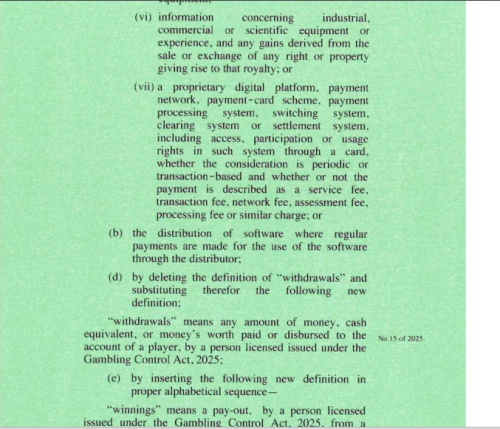
“A proprietary digital platform, payment network, payment-card scheme, payment processing system, switching system, clearing system or settlement system,” the bill states.
“Charges may apply whether the consideration is periodic or transaction-based and whether or not the payment is described as a service fee, transaction fee, network fee, assessment fee, processing fee or similar charge.”
The move could significantly affect banks, fintech firms and payment service providers, with costs that may eventually be transferred to consumers through higher transaction charges.
For ordinary Kenyans already grappling with expensive mobile money, bank and card transaction fees, the changes could further erode household purchasing power.

Tax on transactions
The bill also introduces taxation measures targeting gambling winnings and scrap metal transactions.
Section 7 of the proposed law amends the Income Tax Act by adding the sale of scrap metal and winnings among taxable income streams.
At a time when many unemployed youths increasingly rely on betting and the informal scrap metal trade for survival, the proposal is expected to pull more low-income earners into the tax bracket.

The bill also tightens tax compliance timelines for individuals and businesses.
Under the proposed amendments to Section 52 of the Income Tax Act, taxpayers will now be required to file returns “by the last day of the fourth month following the end of the person’s year of income,” down from the current six months in some cases.
For nil returns, taxpayers must file within one month following the end of the year of income.
The stricter timelines could increase penalties and compliance costs for small businesses and individuals who struggle with filing obligations.
The bill further introduces a new non-resident rental income tax framework.

“A non-resident person earning rental income in Kenya shall register and account for the tax through a simplified registration framework prescribed by the Commissioner,” it proposes.
While the measure targets foreign property owners, economists warn that landlords may ultimately transfer additional compliance and tax costs to tenants through higher rents.
The proposed law also offers a few relief measures, including allowing employees to deduct up to Ksh360,000 in annual interest paid on loans advanced by the Central Bank of Kenya (CBK) for home ownership or improvement.
Still, the overall effect of the bill points to a broader government strategy of tapping previously under-taxed sectors and tightening enforcement as Kenya struggles with rising debt obligations and revenue shortfalls.
The Treasury has repeatedly defended the Bill as a revenue-enhancing rather than tax-increasing measure.
But for households already battling high food prices, elevated electricity costs and stagnant incomes, the distinction may offer little comfort.
If enacted, the bill could deepen the pressure on family budgets, leaving many Kenyans paying more through indirect costs while saving less at the end of the month.
Author
Latest News







Advertisement
More on Business