Dangote expands Tanzania investments as Kenya pushes oil refinery plan
By Kenneth Mwenda, June 28, 2026President Samia Suluhu Hassan has opened fresh talks with Nigerian billionaire Aliko Dangote as Tanzania moves to attract more large-scale industrial investments in East Africa.
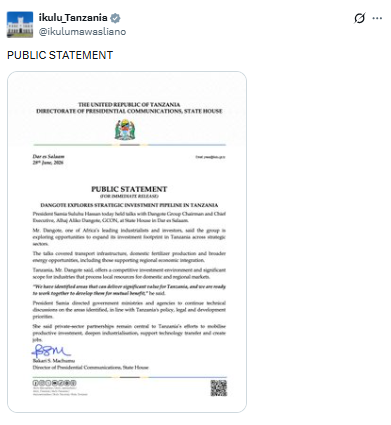
In a public statement released on June 28, 2026, Tanzania’s State House said Dangote met President Samia in Dar es Salaam to discuss new investment opportunities in transport infrastructure, fertiliser production and energy projects.
The meeting comes at a time when Kenya is also aggressively pursuing major energy investments linked to Dangote, including a proposed regional oil refinery championed by President William Ruto.
According to the statement from the Directorate of Presidential Communications, Dangote said Tanzania offers a strong investment climate and major opportunities for industries that process local resources for both domestic and regional markets.
“We have identified areas that can deliver significant value for Tanzania, and we are ready to work together to develop them for mutual benefit,” Dangote said during the meeting.
President Samia directed government ministries and agencies to continue technical discussions on the identified sectors while ensuring the projects align with Tanzania’s legal and development priorities.
The Tanzanian government said private-sector partnerships remain central to its industrialisation strategy, especially in manufacturing, energy production, technology transfer and job creation.
The talks also show Tanzania’s growing effort to position itself as a regional industrial hub instead of remaining mainly an exporter of raw materials.
Dangote already has a major presence in Tanzania through the Dangote Group cement business. The company’s cement plant in Mtwara is one of the largest industrial investments in the country and supplies both local and regional markets.
Industry analysts say the latest discussions suggest Tanzania now wants to deepen cooperation with Dangote in sectors linked to agriculture, energy and infrastructure.
Fertiliser plans could support agriculture
One of the key sectors discussed was domestic fertiliser production.
Tanzania’s agriculture sector remains heavily dependent on imported fertiliser despite rising demand from farmers across East Africa. Local production could reduce import costs, improve supply stability and lower prices for farmers.
Dangote has already built one of Africa’s largest fertiliser plants in Nigeria. The Dangote Fertiliser facility in Lagos produces millions of tonnes annually and supplies several African markets.
A similar investment in Tanzania would strengthen regional food production while reducing dependence on imported farm inputs.
The project would also support Tanzania’s plan to increase agricultural productivity and food exports within the East African Community and the wider African market.
Energy experts say fertiliser production requires stable gas and power supplies, which explains why the discussions also included broader energy investments.
Tanzania has become increasingly attractive to energy investors because of its natural gas reserves and expanding electricity infrastructure.
The country holds significant offshore and onshore natural gas resources, particularly around Mtwara and the Indian Ocean coast. Officials have spent years trying to convert those reserves into industrial growth.
The government has also expanded power generation projects and regional electricity connections aimed at supporting factories and heavy industries.
Dangote’s interest in Tanzania’s energy sector therefore fits into a wider regional push for industrial manufacturing supported by local energy resources.
Analysts say energy investments linked to fertiliser plants, transport infrastructure and manufacturing could help Tanzania reduce industrial production costs while attracting more foreign investors.
The talks also touched on projects supporting regional economic integration, showing Tanzania wants investments that connect with neighbouring economies.
Kenya pushes for regional refinery
While Tanzania focuses on several sectors at once, Kenya has concentrated heavily on securing a regional oil refinery linked to Dangote.
President Ruto has repeatedly said Kenya and regional partners want to reduce dependence on imported petroleum products by refining oil within East Africa.
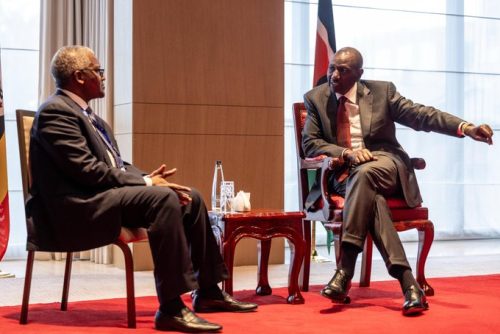
Speaking during the National Prayer Breakfast in May 2026, Ruto confirmed he had held discussions with Dangote on the refinery proposal.
“I had a chat with Mr Dangote yesterday, and he was telling me how much resistance has been built by the people we are buying fuel from now because they want to continue buying their fuel,” Ruto said.
“But we have to make those decisions that will change our country.”
The proposed refinery would reportedly process crude oil from Kenya’s Turkana fields, Uganda and other regional producers.
Dangote first publicly offered to build a refinery in East Africa during the Africa We Build Summit in Nairobi earlier this year.
He said the project could mirror his Lagos refinery, which has become one of the world’s largest single-train refineries.
The Nigerian facility recently exceeded 700,000 barrels per day during performance testing and is targeting further expansion.
Kenya sees the refinery as a long-term solution to fuel security and rising import costs. However, questions remain over the final location, financing structure and timelines.
Early discussions pointed to Tanga in Tanzania because of the East African Crude Oil Pipeline route. Later reports suggested Mombasa and Lamu were also under consideration because of port access and existing infrastructure.
Ruto has maintained that regional governments will not dictate where Dangote eventually builds the refinery.