CS Kagwe unveils digital livestock tracking to strengthen exports
By Aloys Michael, March 30, 2026The government has revealed that all livestock exports will be required to be fully traceable using a revolutionary new technology in a bid to strengthen the country’s export sector.
ANITRAC is a digital platform implemented by the Ministry of Agriculture to track livestock from birth to slaughter. The system was officially launched for its pilot phase on May 22, 2025.
In a statement on Monday, March 30, 2026, the Cabinet Secretary for Agriculture, Mutahi Kagwe, announced that all livestock would be fitted with a technology known as ANITRAC, in line with international standards for animal product traceability.
“Moving forward, exporting animals to international markets must have traceability. That is why we have ANITRAC,” Kagwe said.
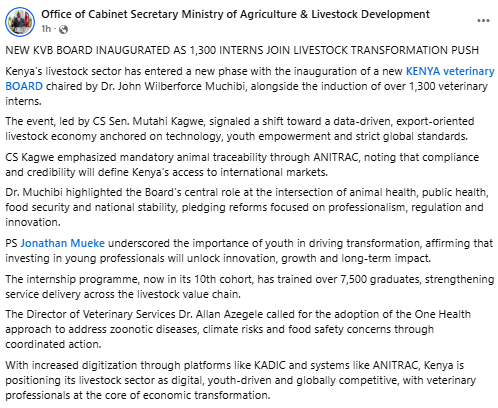
The technology leverages digital microchip tags to store and transmit animal data. This strategy was aimed at enhancing animal disease control, preventing livestock theft, ensuring food safety, and securing international market access.
CS Kagwe said the directive during the inauguration of the new Board at the Kenya Veterinary Board (KVB). The event also saw the induction of more than 1,300 veterinary interns.
Kagwe assured that the government will give the necessary support to ensure that veterinarians are at the centre of the digital transformation in the agriculture sector.
“The shift to digital is not just a technological upgrade but a complete redefinition of veterinary practice, requiring new competencies in data, remote services, and real-time decision-making,” Kagwe stated.
Kenya’s livestock export sector is primarily focused on the Middle East, with substantial shipments of live animals and meat products, particularly sheep, goats, and camels, being shipped there every day.
As of 2024, the country’s meat export industry was valued at approximately Ksh13 billion, with live animal exports generating Ksh2.2 billion.
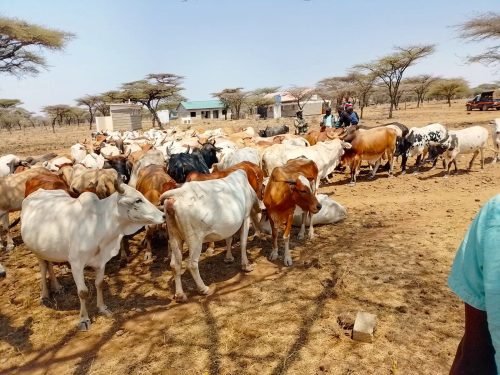
Earlier in March 2026, the CS said that ongoing conflicts in the Middle East were causing Kenya to lose Ksh300 million in daily livestock export revenue.
During a press briefing on Thursday, March 12, 2026, he noted that the country’s livestock export industry heavily relies on the Middle East, with significant shipments of live animals and meat products, including sheep, goats, and camels.
Kagwe added that the government has begun efforts to identify and secure alternative markets to quickly offset the impact of disrupted trade routes.
He particularly focused on the food products that the country has been selling to Iran, saying that they have been impacted.

“Whereas there are some products that have already begun to be impacted; for example, we send to the Middle East about Ksh300 million worth of meat and animal products every week, and that is something we have to be thinking about,” Kagwe said.
Kagwe further said that the government is closely monitoring the Dubai Multi Commodities Centre (DMCC), a critical distribution and mixing point for Kenyan tea destined for Middle Eastern markets.
Finding alternative markets
He noted that efforts are underway to find alternative markets for goats and meat products to replace those currently situated in conflict zones.
“However, we have also taken measures to ensure that we are looking elsewhere. For example, when it comes to the meat markets, there are also alternative markets that have risen as a result of the same situation,” Kagwe stated.
Despite the challenges, the government maintains that it is taking proactive steps to shield the economy from a wider crisis.