Advertisement
COMESA issues warning as Middle East crisis sparks fears of market extortion
Saturday 21st March, 2026 02:53 PM|

The COMESA Competition and Consumer Commission (CCCC) has issued a stern warning to businesses across its member states against engaging in anti-competitive conduct and unfair trade practices amid ongoing disruptions linked to the Middle East crisis.
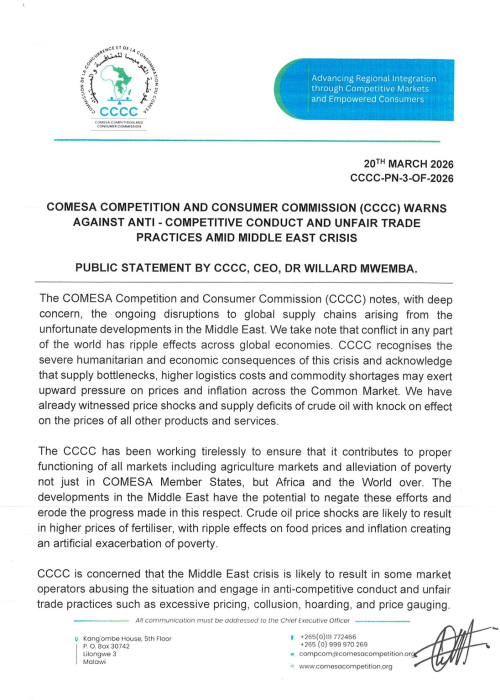
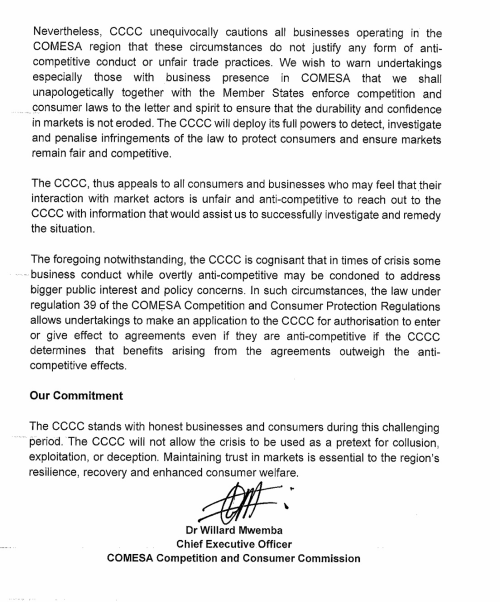
In a press statement dated March 20, 2026, that was shared via social media on Saturday, March 21, CCCC Chief Executive Officer Willard Mwemba expressed concern that the conflict is already triggering supply chain disruptions, higher logistics costs, and commodity shortages, factors that could drive up prices across the region.
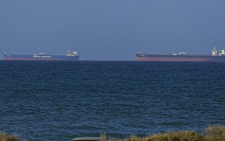
The commission noted that early signs of strain are already visible, particularly in global crude oil markets, where price shocks are beginning to ripple across sectors, raising the cost of goods and services.
“The COMESA Competition and Consumer Commission (CCCC) notes, with deep concern, the ongoing disruptions to global supply chains arising from the unfortunate developments in the Middle East. We take note that conflict in any part of the world has ripple effects across global economies,” the statement reads in part.
You Might Also Like

“CCCC recognises the severe humanitarian and economic consequences of this crisis and acknowledge that supply bottlenecks, higher logistics costs and commodity shortages may exert upward pressure on prices and inflation across the Common Market. We have already witnessed price shocks and supply deficits of crude oil with knock on effect on the prices of all other products and services.”
Price hikes
Mwemba further warned that rising fuel costs could translate into higher fertiliser prices, increased food costs, and inflationary pressure that may worsen poverty levels in COMESA member states.
The regulator cautioned that some businesses may seek to exploit the crisis through practices such as excessive pricing, hoarding, collusion, and price gouging.
“CCCC is concerned that the Middle East crisis is likely to result in some market operators abusing the situation and engage in anti-competitive conduct and unfair trade practices such as excessive pricing, collusion, hoarding, and price gauging,” the regulator stated.
However, Mwemba emphasised that the prevailing global situation does not justify any form of market abuse.
“Nevertheless, CCCC unequivocally cautions all businesses operating in the COMESA region that these circumstances do not justify any form of anti-competitive conduct or unfair trade practices. We wish to warn undertakings especially those with business presence in COMESA that we shall unapologetically together with the Member States enforce competition and consumer laws to the letter and spirit to ensure that the durability and confidence in markets is not eroded,” CCCC warned.
“The CCCC will deploy its full powers to detect, investigate, and penalise infringements of the law to protect consumers and ensure markets remain fair and competitive.”
Consumer protection
The CCCC called on consumers and businesses to report any suspected cases of unfair trade practices, assuring that such information would assist in investigations and corrective actions.
The commission also reiterated its commitment to safeguarding market integrity and protecting consumers during the challenging period, stressing that trust in markets is critical for economic resilience and recovery.
At the same time, the regulator acknowledged that in certain exceptional circumstances, some forms of collaboration between businesses, though potentially anti-competitive, may be permitted if they serve a broader public interest.
Such arrangements, the commission said, must be formally approved under COMESA regulations, which allow exemptions where the benefits outweigh the negative effects on competition.
Ruto urges global action
This comes days after President William Ruto strongly condemned the widening wave of strikes across the Middle East, warning that the growing regionalisation of the conflict poses a grave threat to international peace and security.
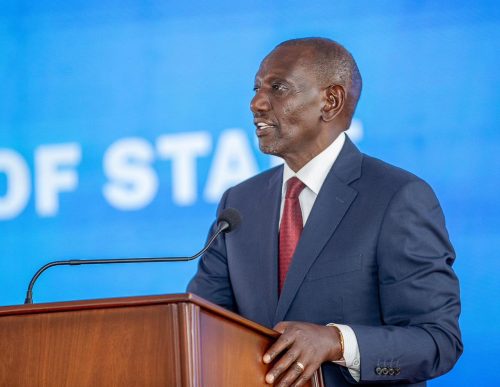
Taking to his official social media accounts on Monday, March 2, 2026, Ruto denounced attacks targeting several Gulf and regional states, including the United Arab Emirates, Qatar, Saudi Arabia, Iraq, Oman, Kuwait, Jordan, and Bahrain.
“Kenya strongly condemns the strikes on the UAE, Qatar, Saudi Arabia, Iraq, Oman, Kuwait, Jordan, and Bahrain in the evolving conflict in the Middle East. It is evident that the regionalisation of this conflict poses a grave threat to international peace and security,” Ruto stated.
Author
Mustafa Juma
View all posts by Mustafa JumaLatest News





Advertisement
More on Business