CBK licenses 25 more digital lenders as applications top 800 since 2022
By Kenneth Mwenda, July 14, 2026The Central Bank of Kenya (CBK) has revealed that it has received more than 800 applications from digital credit providers since March 2022, highlighting the rapid growth of Kenya’s digital lending sector even as the regulator tightens oversight.
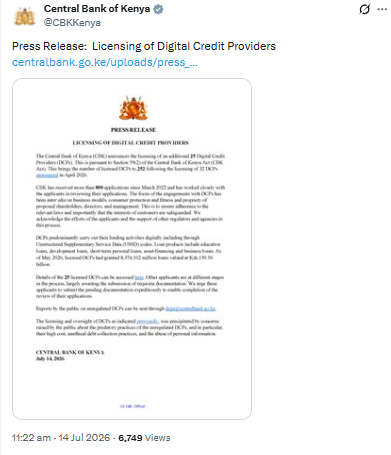
The disclosure came on Tuesday, July 14, 2026, when CBK announced the licensing of 25 additional Digital Credit Providers (DCPs) under Section 59(2) of the Central Bank of Kenya Act.
The latest approvals raise the total number of licensed digital lenders in Kenya to 252, up from 227 announced in April 2026.
Over 800 applications under review
According to CBK, the regulator has been reviewing applications for more than four years to ensure only firms that meet legal and consumer protection requirements are allowed to operate.
The regulator said it has worked closely with applicants throughout the review process, examining their business models, governance structures and compliance with the law.
“CBK has received more than 800 applications since March 2022 and has worked closely with the applicants in reviewing their applications,” the regulator said in a statement.
It added that the review has focused on business models, consumer protection, and the suitability of proposed shareholders, directors and senior management.
“The focus of the engagements with DCPs has been inter alia on business models, consumer protection and fitness and propriety of proposed shareholders, directors, and management. This is to ensure adherence to the relevant laws and importantly that the interests of customers are safeguarded,” CBK said.
The central bank also acknowledged the cooperation of applicants, regulators and other government agencies involved in the licensing exercise.
Why CBK started licensing digital lenders
CBK began regulating digital credit providers after widespread complaints from borrowers about the conduct of many unregulated loan apps.
Before the licensing framework came into effect in 2022, dozens of mobile lenders operated with little regulatory oversight.
Many customers accused some lenders of charging extremely high borrowing costs, using aggressive debt collection methods and misusing personal information obtained through mobile applications.
Some borrowers also complained that lenders contacted family members, friends and work colleagues when recovering loans, raising concerns about privacy and data protection.
CBK said the licensing and supervision of digital credit providers was introduced to address these concerns.
“The licensing and oversight of DCPs… was precipitated by concerns raised by the public about the predatory practices of the unregulated DCPs, and in particular, their high cost, unethical debt collection practices, and the abuse of personal information,” the regulator stated.
The licensing process now aims to ensure digital lenders comply with financial laws while protecting borrowers from unfair practices.
Most applicants yet to receive licences
Although CBK has received more than 800 applications, only 252 digital lenders have so far been licensed.
This means hundreds of applicants are still waiting for approval or are yet to complete the licensing process.
According to the regulator, many of the remaining applicants are at different stages of review, with several yet to submit all the required documents.
CBK urged these firms to provide the outstanding documentation without delay to enable the completion of the review process.
“Other applicants are at different stages in the process, largely awaiting the submission of requisite documentation. We urge these applicants to submit the pending documentation expeditiously to enable completion of the review of their applications,” CBK said.
The regulator did not disclose how many applications had been rejected or withdrawn.
Digital lending continues to expand
Even as regulation becomes stricter, digital lending continues to play a major role in expanding access to credit in Kenya.
Most licensed Digital Credit Providers issue loans through mobile applications and Unstructured Supplementary Service Data (USSD) platforms, allowing customers to borrow without visiting a physical branch.
The products offered by licensed lenders include short-term personal loans, business loans, education loans, development loans and asset-financing facilities.
CBK data shows the sector has continued to grow despite tighter regulation.
As of May 2026, licensed digital credit providers had issued 8,374,102 loans worth Ksh150.56 billion.
The figures indicate continued demand for quick mobile loans from individuals and small businesses seeking convenient access to credit.
Compared with previous updates from the regulator, the value and number of loans issued by licensed lenders have increased steadily.
In December 2025, licensed digital lenders had issued about 6.6 million loans worth Ksh109.8 billion.
By February 2026, that figure had risen to about 7.5 million loans valued at Ksh133.5 billion.
The latest data for May 2026 now places the total at more than 8.37 million loans worth Ksh150.56 billion, reflecting continued growth in digital borrowing.
CBK has also urged members of the public to report any digital lenders operating without approval.
The regulator said complaints about unregulated digital credit providers can be submitted through its dedicated email address.
The move forms part of CBK’s wider efforts to eliminate illegal loan apps and strengthen confidence in Kenya’s digital lending market.
By licensing providers and monitoring their operations, the central bank aims to ensure borrowers have access to credit from institutions that meet regulatory standards while protecting consumers from exploitation.
The continued review of hundreds of pending applications suggests that Kenya’s digital lending market will keep evolving as more firms seek approval to enter the regulated sector.