Budget vs Finance Bill: Clearing the confusion for many Kenyans
By Faith Lagat, March 14, 2026If you’ve ever scrolled through news or social media during budget season and thought, “Wait, isn’t the Budget the same thing as the Finance Bill?” you’re not alone.
Many Kenyans mix up these two crucial parts of our public finance system. No wonder the lines blur! People hear about new spending on roads, schools, or health, then suddenly face proposed taxes on fuel, mobile money, or goods and wonder how it all connects or doesn’t.
The National Budget
The National Budget is the government’s spending roadmap the “what” we plan to achieve in the financial year.
Guided by Article 221 of the Constitution, the Cabinet Secretary for National Treasury submits estimates of revenue and expenditure to the National Assembly for approval.
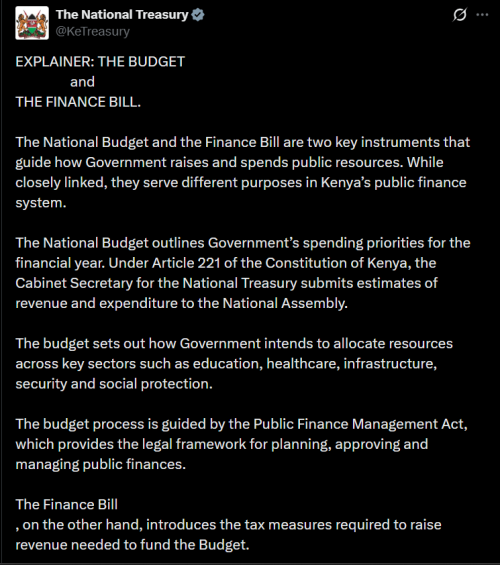
“The National Budget outlines Government’s spending priorities for the financial year. Under Article 221 of the Constitution of Kenya, the Cabinet Secretary for the National Treasury submits estimates of revenue and expenditure to the National Assembly,” read the National Treasury X post in part.
It details resource allocation across vital sectors: education (better schools and teacher pay), healthcare (more facilities and services), infrastructure (roads, housing, urban development), security (police and defence), and social protection (support for vulnerable groups).
Just on March 10, 2026, the National Assembly approved the 2026 Budget Policy Statement, locking in broad spending limits for FY 2026/27.
The national government ceiling stands at Ksh 2.878 trillion, with the Executive getting Ksh 2.797 trillion, Parliament Ksh 50.78 billion, and the Judiciary Ksh 30.44 billion. Counties receive an equitable share of Ksh 420 billion, plus Ksh 75.69 billion in additional allocations and Ksh 9.6 billion for the Equalisation Fund.
Key allocations in the 2026 budget
Highlights include massive investments in security with Ksh 143.19 billion for the National Police Service and Ksh 241.36 billion for Defence. Education receives Ksh 422.95 billion for the Teachers Service Commission, Ksh 134.78 billion for basic education, and Ksh 160.09 billion for higher education.
Infrastructure allocations include Ksh 232.11 billion for roads and Ksh 139.33 billion for housing. Health funding stands at Ksh 134.3 billion for medical services and Ksh 33.1 billion for public health.
Total expenditure and net lending is projected at Ksh 4.7 trillion, with a deficit capped at 5.3 percent of GDP. These figures aim to balance growth ambitions while managing borrowing responsibly.
Finance Bill: Funding the budget
Spending plans need money enter the Finance Bill, the revenue engine that funds the budget. Under Articles 209 and 210 of the Constitution, taxes and levies require parliamentary legislation.
The Finance Bill proposes amendments to laws such as the Income Tax Act, VAT Act, and Excise Duty Act to raise funds through new measures, adjustments, or exemptions.
In short: the Budget sets priorities and allocations (what gets funded), while the Finance Bill delivers the tax changes (how to pay for it). Without approved revenue measures, spending ambitions could lead to higher deficits or borrowing.
“The Finance Bill therefore proposes amendments to tax laws such as the Income Tax Act, VAT Act and Excise Duty Act to implement the Government’s revenue proposals.”
The Finance Bill process has real consequences, as Kenyans experienced in 2024 when controversial clauses introduced late in Parliament triggered nationwide protests.

Many, particularly young people, felt their views had been ignored. This year, the clearer notice from the Treasury provides an opportunity for citizens to submit specific, well-researched proposals, which usually receive more attention than general complaints. Past submissions from individual taxpayers have even led to policy changes.
With public debt still high and revenue needs growing, the Finance Bill 2026 will play a major role in shaping the country’s tax direction. The Treasury has now opened the door, giving Kenyans three weeks to influence the taxes they will pay from July 2026.
To ensure the Finance Bill reflects public needs, the National Treasury opened calls for tax policy proposals in December 2025, inviting submissions from citizens, businesses, NGOs, and others until December 31, 2025.
This early engagement, rooted in Articles 201 and 232 of the Constitution and the Public Finance Management Act, aims to incorporate well-justified ideas aligned with the Bottom-Up Economic Transformation Agenda.