Bond market turnover declines as Kenya’s Eurobond yields rise
By Faith Lagat, July 5, 2026Kenya’s domestic secondary bond market recorded lower trading activity during the week ending July 2, 2026, even as yields on the country’s Eurobonds increased, according to the Central Bank of Kenya’s latest Weekly Bulletin.
The bulletin shows that turnover in the secondary bond market declined by 22.66 per cent compared to the previous week. The drop came even as inflation eased and the Kenya shilling remained stable against the US dollar.
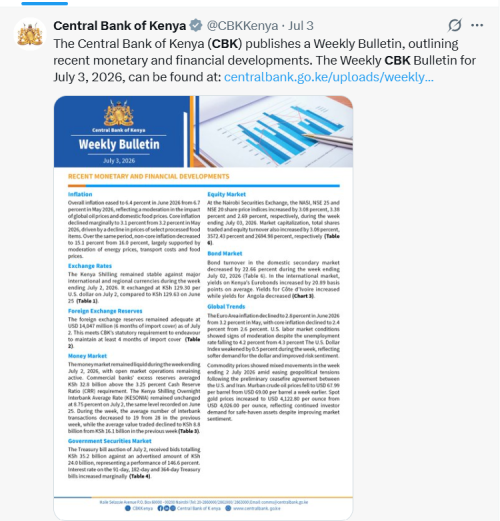
“Bond turnover in the domestic secondary market decreased by 22.66 per cent during the week ending July 02, 2026. In the international market, yields on Kenya’s Eurobonds increased by 20.89 basis points on average. Yields for Côte d’Ivoire increased while yields for Angola decreased,” the Central Bank of Kenya said in its Weekly Bulletin dated July 3, 2026.
At the primary market, however, investor demand for government securities remained strong. The Treasury bill auction held on July 2 attracted bids worth Ksh 35.2 billion against an advertised amount of Ksh 24.0 billion, translating to an oversubscription of 146.6 per cent.
Average interest rates for the 91-day, 182-day and 364-day Treasury bills increased slightly during the auction.
Eurobond yields edge higher
The Central Bank said yields on Kenya’s Eurobonds rose by an average of 20.89 basis points during the review period.
The increase was recorded across several maturities, including the 2028 Eurobond. The bulletin also showed varying trends across other African sovereign bonds, with Côte d’Ivoire registering higher yields while Angola recorded declines.
The bulletin also highlighted continued stability in Kenya’s macroeconomic indicators.
Headline inflation eased to 6.4 per cent in June 2026 from 6.7 per cent in May 2026, supported by lower food prices and declining global oil prices. Core inflation also declined slightly to 3.1 per cent.
The Kenya shilling remained stable, trading at Ksh129.30 against the US dollar on July 2 compared to Ksh129.63 a week earlier.
Foreign exchange reserves increased to Ksh1.82 trillion, equivalent to six months of import cover, remaining above the statutory minimum requirement of four months.
Equity market posts gains
The money market remained liquid during the review period, with commercial banks holding average excess reserves of Ksh 32.8 billion above the required Cash Reserve Ratio of 3.25 per cent.
The Kenya Shilling Overnight Interbank Average Rate (KESONIA) remained unchanged at 8.75 per cent.
Interbank activity, however, slowed, with the number of deals declining from 28 to 19, while the value traded fell from Ksh16.1 billion to Ksh8.8 billion. Meanwhile, the Nairobi Securities Exchange recorded gains across its major indices.
The NSE All Share Index (NASI) rose by 3.08 per cent, the NSE 25 Share Index gained 3.38 per cent, while the NSE 20 Share Index increased by 2.69 per cent.
Market capitalisation, total shares traded and equity turnover also posted increases during the week.
The Central Bank bulletin further noted mixed developments in the global economy, including easing inflation in the Euro Area, a weaker US Dollar Index and lower global crude oil prices following reduced geopolitical tensions. Gold prices, however, rose during the review period.
The weekly bulletin shows that while activity in the domestic secondary bond market slowed, investor demand for Treasury bills remained strong and key macroeconomic indicators, including inflation, foreign exchange reserves and the exchange rate, remained stable.