Advertisement
Bond market activity soars 57% amid equity slowdown
Sunday 22nd February, 2026 07:16 AM|

Kenya’s financial markets recorded mixed performance in the week ending February 19, with a sharp rise in bond market activity contrasting with a slowdown in equities, according to the latest bulletin by the Central Bank of Kenya (CBK).
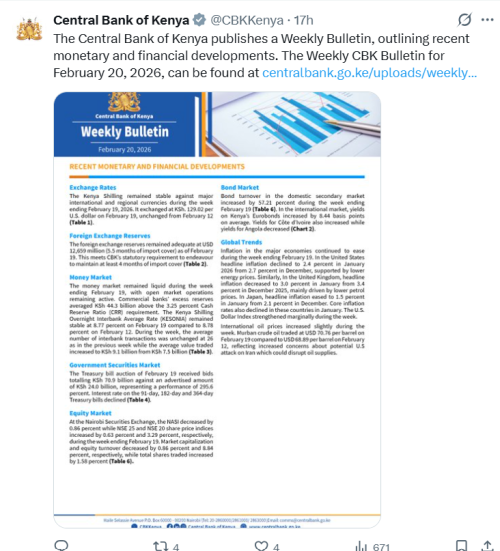
Bond turnover in the domestic secondary market increased by 57.21 percent during the period under review, reflecting heightened activity in fixed-income trading.
The increase came as Treasury bill auctions also recorded strong investor demand, with total bids of Ksh 70.9 billion against an advertised amount of Ksh 24.0 billion, representing a performance of 295.6 percent.
Interest rates on Treasury bills declined across all tenors, with the 91-day paper at 7.59 per cent, the 182-day at 7.75 per cent and the 364-day at 8.90 per cent, indicating sustained appetite for government securities.
You Might Also Like


“Bond turnover in the domestic secondary market increased by 57.21 percent during the week ending February 19. In the international market, yields on Kenya’s Eurobonds increased by 8.44 basis points on average. Yields for Côte d’Ivoire also increased while yields for Angola decreased.”
Equity market records mixed performance
At the Nairobi Securities Exchange (NSE), equity indicators showed mixed trends during the week. The Nairobi All Share Index (NASI) declined by 0.86 per cent, while the NSE 25 and NSE 20 share indices increased by 0.63 per cent and 3.29 per cent respectively.
Market capitalisation decreased by 0.86 per cent as equity turnover dropped by 8.84 per cent, even as the total number of shares traded rose by 1.58 per cent. The data pointed to reduced overall activity despite gains in selected counters.
The CBK bulletin also noted that yields on Kenya’s Eurobonds in the international market increased by an average of 8.44 basis points during the week.
Stable shilling and adequate reserves
The Kenya shilling remained stable against major international and regional currencies, exchanging at Ksh 129.02 per US dollar on February 19, unchanged from the previous week.
Foreign exchange reserves rose to USD 12,659 million, equivalent to 5.5 months of import cover, remaining above the statutory requirement of at least four months.
The money market remained liquid, supported by active open market operations. Commercial banks’ excess reserves averaged Ksh 44.3 billion above the 3.25 per cent cash reserve ratio requirement, while the Kenya Shilling Overnight Interbank Average Rate (KESONIA) remained stable at 8.77 per cent compared to 8.78 per cent the previous week.
Global inflation trends ease
Globally, inflation continued to ease across major economies. In the United States, headline inflation declined to 2.4 per cent in January from 2.7 per cent in December, while the United Kingdom recorded a drop to 3.0 per cent from 3.4 per cent. Japan’s inflation also eased to 1.5 per cent from 2.1 per cent.
International oil prices increased slightly during the week, with Murban crude trading at USD70.76 per barrel on February 19 compared to USD68.89 the previous week.
Author
Latest News








Advertisement
More on Business