Advertisement
Bishop delivers gospel of food security from pulpit
Friday 08th September, 2023 05:50 AM|
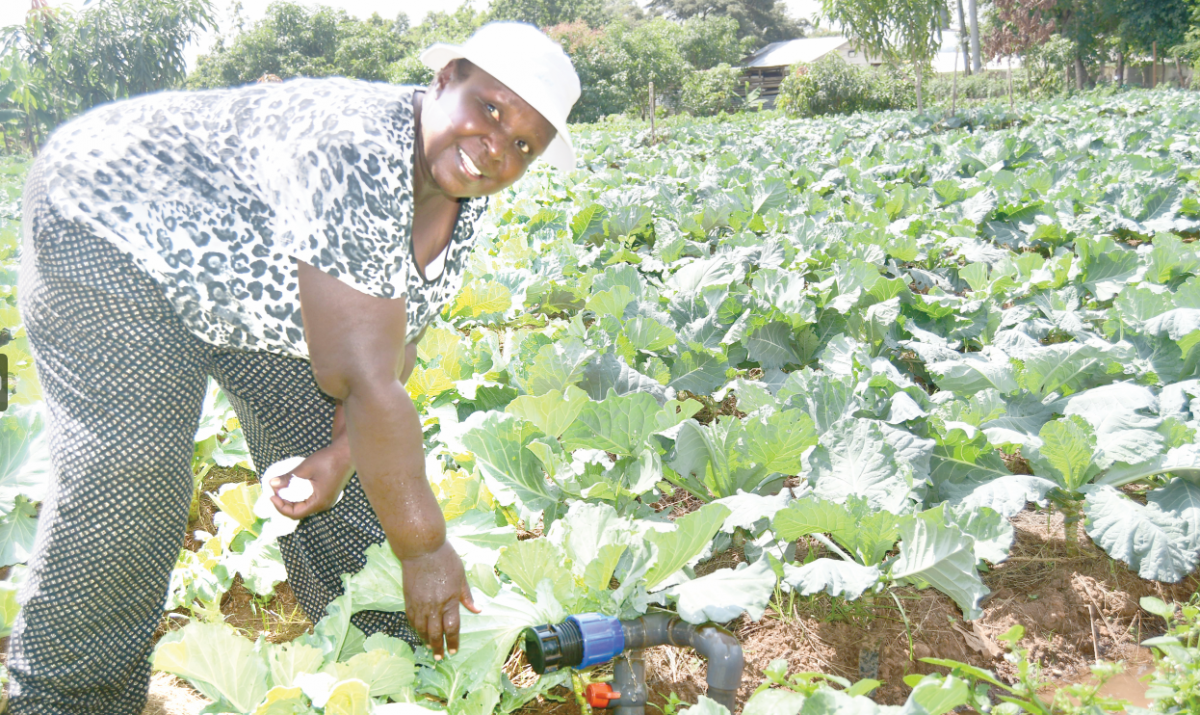
Bishop Phoebe Onyango, 45, is a woman of many firsts. When she is not proclaiming God’s word from the pulpit as Bishop she is out in the field teaching about agri-business in Siaya County where she is a prolific farmer.
Phoebe, is one of the few women in the villages who have embraced intensive farming as a source of food and nutritional security, adopting the multi-cropping farming practice to grow a variety of crops in the same piece of land each planting season.
Each day, she works hard in the farm to improve nutrition, food safety and food security. The dynamics of poverty within rural areas, has shaped her, and directly influenced her active involvement in agricultural sector.
Currently, it is estimated that 46 per cent of the population live on less than $1 a day while 36.5 per cent are food insecure.
But Phoebe is out to change this narrative and break the glass ceiling in Nyamonye village, Bondo sub-county where her farm is. When we visited her rural farm, we found the woman of faith, busy weeding in her five-acre farm.
Each day, Bishop Phoebe spends more than eight hours tending to her “one-stop-shop farm”, with all the food items we need daily. Her farming model involves sowing 15 or more crops on the same plot, and harvesting them at different times.
“We grow everything in this farm, ranging from kales, onions, tomatoes, sukuma wiki, beans, grains, and millets,’’ she explains. A walk into the farm, revealed exactly what she explained.
hoebe also grows nearly all types of edible plants and fruits and rears poultry bird and animals of various breeds for meat and milk production.
Bishop Phoebe is the founder of Salem Ministries International, which has footprints in Nyanza. The church has branches in Kisumu and Siaya, Homa Bay and Migori counties.
She says their members are indoctrinated to adopt new farming methods to ensure food and nutritional security.
“Many of our followers or flock have today ventured into a massive agri-business farming system,’’ she reveals. They are taken to her farm to learn and borrow leaf and are supported with free seedlings and technical planting skills.
She has employed an agriculture extension officer, who is helping her to shape the intercropping farming model. Currently, most of those who work in her farm are also mostly members of her church and feed from what they sow.
They are given vegetables and onions in plenty each day and times even eggs, fish or fruits or meat if they slaughter a goat.
The estimated 40 casual labourers buy food items at subsidised costs, on top of the freebies they get when they work on the farm and are paid. They are paid between Sh200 to Sh300 depending on the manual work done.
Phoebe’s model of farming has kept her busy in her farm daily, walking round tending to her farm to ensure food security.
For her, the intercropping system has helped her to double crop productivity and household income per capita.
But, the selection of more crops for practicing multi-cropping, she notes, mainly depends on the mutual benefit of the selected crops.
She says that threshing can at times be difficult in the inter-cropping systems where crops are harvested together.
“This can take the form of double-cropping, in which a second crop is planted after the first has been harvested,’’ Phoebe adds At any interval, if they are not planting, then they are weeding or harvesting mature crops or milking cows or hatching eggs. Phoebe is one of the rare women of cloth, who rather than rely on praying for “manna” from heaven, is practical.
“Prayers is good, for God to provide us with all we need, but we must also toil or work hard in the farms,’’ she explains.
Bishop has been shepherding her flock to embrace farming as the only source of food and nutritional security.
She encourages them, where possible, to adopt the farming practice which can help in reducing the food crises. Asked whether it was too expensive, she says not so much.
“One can start in a small way with traditional vegetables and expand to other plants and poultry,’’ Phoebe adds.
She claims that growing two or more than two crops on the same field reduces the cost of fertilisers and farm inputs.
Risk of weed growth, pest and disease infestation also reduces because of mutual relationships within the crop. She relies both on rainfed agriculture and irrigation of the multi-cropped land. Phoebe’s farm is now being used as a model learning centre in Nyanza.
Author
Kepher Otieno
View all posts by Kepher OtienoLatest News






Advertisement
More on Business