Advertisement
Kenyan elections most competitive in E. Africa region
Tuesday 14th June, 2022 01:30 AM|
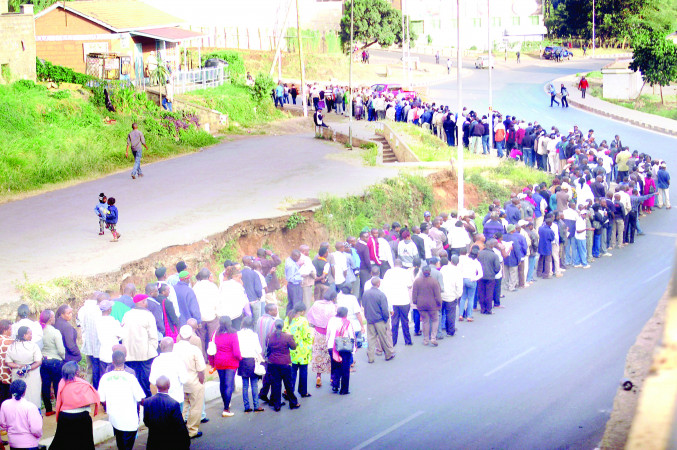
Kenyan elections are among the most competitive in East and Central Africa, with politics dominated by personalities and money rather than first – or second-generation scions of an armed liberation movement who are reluctant to relinquish power, as in several other countries in the region.
Opposition candidates can campaign more freely than those in most nearby countries and outcomes are usually uncertain even days before voting occurs.
An entrenched culture of leadership rotation, with presidents legally required to step down at the end of two terms, further sets the country apart from many in the neighbourhood. These competitive votes sometimes strain the country’s institutions to the breaking point, however.
In December 2007, following a vote that international observers deemed deeply flawed, serious violence broke out when electoral authorities ruled that incumbent Mwai Kibaki had defeated opposition challenger Odinga.
Odinga supporters took to the streets to protest an outcome they viewed as fraudulent. During the next eight weeks, intercommunal clashes in various parts of the country and a heavyhanded police response killed close to 1,100 people and displaced over 600,000. The crisis eased in February 2008, when Kibaki and Odinga signed a power-sharing agreement brokered by former UN Secretary-General Kofi Annan.
Under the terms of that deal, the pair were to lead a government of national unity, with Kibaki retaining the presidency and Odinga taking the prime minister’s post. The 2008 agreement and the unity government it generated paved the way for deep institutional reforms that culminated in the adoption of a new constitution in August 2010.
That charter, one of the most progressive on the continent, introduced significant changes to Kenya’s system of government, most importantly by whittling down the presidency’s remit and devolving powers and resources to locally elected leaders.
It also gave Parliament the authority to vet presidential appointees and strengthened the judiciary by insulating judges from executive pressure through the formation of an independent commission responsible for appointing judges and running judicial affairs.
Not all the reforms agreed to on paper have borne fruit, but some have. On one hand, Parliament, which is dominated by the ruling Jubilee Party, has hardly used its expanded powers to serve as a check on the executive and still mainly toes the government line.
On the other hand, the Judiciary has emerged as arguably the most important safeguard of the Constitution. It is staffed by strong, independent judges, with a track record of ruling against the executive branch where warranted.
Strong judiciary
Indeed, in 2017, the Supreme Court annulled the results of the presidential election because the court determined, it was not conducted in full conformity with the Constitution and electoral laws.
Against this backdrop, candidates who feel aggrieved by the electoral process might seek recourse in the courts with some confidence that they will receive a fair hearing.
Despite the emergence of a stronger Judiciary and other substantial institutional changes, Kenya remains highly vulnerable to episodes of pre and post-election violence. That is mainly due to the polarised, ethnically-driven and personalist politics that has been a feature of electoral competition in the country for decades.
Five potential drivers of violence are of particular concern as the 2022 electoral cycle approaches. The most prominent is elite polarisation.
As outlined below, relations between President Uhuru Kenyatta and his deputy, William Ruto, have seemingly broken down, perhaps irretrievably.
In September 2021, the Catholic Church urged the two to patch things up, saying their open differences were “dangerous for the prevailing peace and tranquillity in the country”.
In several interviews, diplomats and senior figures in Kenyatta’s and Ruto’s camps pointed to these tensions, and in particular, the sense that neither candidate feels he can afford a defeat, as the biggest potential destabilising factor in the run-up to the election. Secondly, the Kenyatta-Ruto rift has contributed to perceptions that the security services may not be neutral during the elections.
IEBC role
On a number of occasions, officials of the United Democratic Alliance (UDA), the party with Ruto on its ticket, have complained that the security forces tried to influence campaigning during the 2021 by-elections in favour of state-backed candidates.
In July 2021, authorities temporarily suspended vote-counting in a by-election in the County of Kiambu after members of President Kenyatta’s Jubilee Party, accompanied by the police, stormed the tallying centre. Despite the incident, UDA candidate John Njuguna won. Yet UDA officials viewed the behaviour of the security officers as a worrying portent of their potential conduct during electioneering in August.
Thirdly, institutions with a critical role in elections management, notably the IEBC, are weak and insufficiently prepared for the polls. The Independent Review Commission, an international commission of inquiry appointed in the aftermath of the 2008 violence and headed by retired South African judge Johann Kriegler, prominently recommended that electoral laws and personnel to lead the electoral commission should be in place at least two years before polling day. Authorities have thus far ignored most of the commission’s recommendations, however, including this one.
Held back by divisions and foot-dragging among commissioners, the electoral body’s leadership took almost four years to appoint a chief executive officer after the previous office holder left in 2018. IEBC finally named a new CEO in March.
IEBC funding has also been a problem. The commission said it needed close to $352 million to organise elections; it had received only a quarter of that amount by the end of 2021.
In February, Kenyan lawmakers made $191 million available for the August polls.19 In March, they approved an additional $76 million, still well below the amount the commission believes is necessary to run a proper election.
—This is an extract from the International Crisis Group (ICG) report
TOMORROW: Why support for leading presidential candidates is likely to swing drastically at the last minute before elections
Author
PD columnist
View all posts by PD columnistLatest News







Advertisement
More on August 9