Advertisement
What to look out for at the quarter-final stage of the Asian Cup
Friday 02nd February, 2024 01:00 AM|
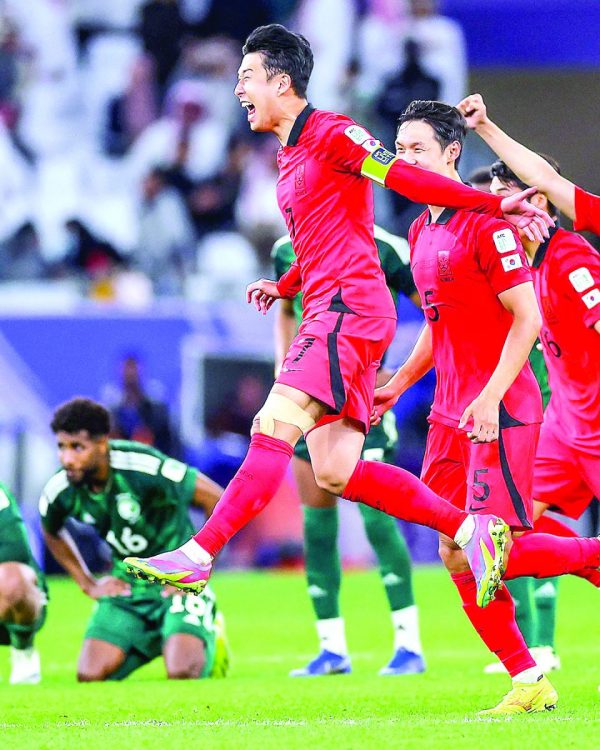
The Asian Cup has already thrown up its share of surprises and more may await as the competition reaches the quarter-final stage.
There are two heavyweight clashes in the last eight, as Australia meet South Korea and Iran face Japan.
But there are also appearances for the world’s 106th-ranked side Tajikistan, who face Jordan, and a talented Uzbekistan side, who take on Qatar.
BBC Sport looks at the best stories as the business end of the competition approaches.
The quarter-final that Asia didn’t know it needed, between two teams dreaming of a first-ever last-four spot. There’s more to the story than that, however.
Tajikistan, making just their second appearance at the finals, went wild after beating United Arab Emirates in a penalty shootout on Sunday.
There was added emotion given that 33-year-old star striker Manuchekhr Dzhalilov, who was diagnosed with cancer last summer, was watching from the stands.
“He is the top scorer in Tajikistan history and our best striker, so of course we missed him,” said the team’s German coach Petar Segrt.
“But for him it is not a discussion of playing or not, it is a story of life and death. He is with us here, we are happy to have him and that is a good motivation for us.”
Both teams have a similar style – they like to counter-attack – but their coaches have very different personalities, with the exuberant Segrt in contrast to his quieter opposite number.
Moroccan Hussein Ammouta has won titles in Africa but went into the Asian Cup under pressure after a run of five defeats and two draws in the second half of 2023.
They came through their group as one of the best third-placed teams, having beaten Malaysia 4-0 and drawn 2-2 with South Korea, before an epic 3-2 victory over Iraq in the last 16, courtesy of two goals in injury time.
Such drama belied Jordan’s slightly dour reputation and a first semi-final appearance could be within reach with the help of Montpellier winger Mousa Al-Taamari. Just don’t call him the Jordanian Messi – he doesn’t like it.
A repeat of the 2015 final, which Australia won, features two teams who have so far underwhelmed. There is one major difference, however. Australia’s progress has been relatively comfortable. South Korea’s has not.
Slightly lucky to draw with Uzbekistan in the group stage, the Socceroos didn’t find India and Syria too much trouble. In the second round on Sunday, Indonesia caused problems initially but Australia won 4-0.
More than 48 hours later, South Korea took on Saudi Arabia in a tense last-16 match that, with injury time and extra time thrown in, lasted more than 130 minutes, before they won on penalties. This came after two dramatic group matches – with a last-minute own goal needed to draw 2-2 with Jordan, and a torrid match against Malaysia, who forced a 3-3 draw with an equaliser in the 15th minute of stoppage time.
Coach Jurgen Klinsmann, already under pressure, faces a tough job in Friday’s quarter-final – his side have had under 72 hours to prepare; Australia have had more than 120.
The Socceroos also have Harry Souttar. The Leicester City defender scored his 11th international goal against Indonesia, not bad for only his 26th appearance. The height and aerial ability of the Aberdeen-born centre-back is proving an undoubted asset.
Kim Min-jae may fancy his chances of making an impact – but the Bayern Munich centre-back knows that South Korea need to improve. The Taeguk Warriors have not lifted the trophy since 1960 and, apart from Paris St-Germain’s Lee Kang-in, have yet to impress.
Author
Story Agencies
View all posts by Story AgenciesLatest News






Advertisement
More on Sports