Women bear brunt of graft as bribery, sextortion risks rise – report
By Faith Lagat, April 18, 2026Kenyan women continue to face a disproportionate burden of corruption, with higher exposure to bribery and sextortion in both public and private services, according to the Kenya National Gender and Corruption Survey 2025 released by the Ethics and Anti-Corruption Commission.
The survey, conducted with support from the United Nations Office on Drugs and Crime, Kenya National Bureau of Statistics, National Gender and Equality Commission and Transparency International Kenya, covered more than 16,000 respondents across all 47 counties.
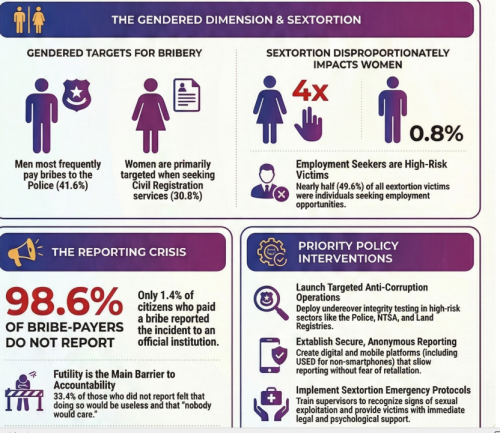
According to the Transparency International Kenya X post dated April 18, 2026, women were more likely to encounter bribery in sectors such as civil registration, healthcare and taxation. Female respondents reported paying bribes most frequently to civil registration officials at 30.8 per cent, followed by tax officers at 19.8 per cent, immigration officials at 12.7 per cent and health workers at 6.7 per cent.
The national average bribe rose from Ksh4,878 in 2024 to Ksh6,724 in 2025, with cash accounting for 72.2 per cent of payments, most of which were demanded before services were rendered.
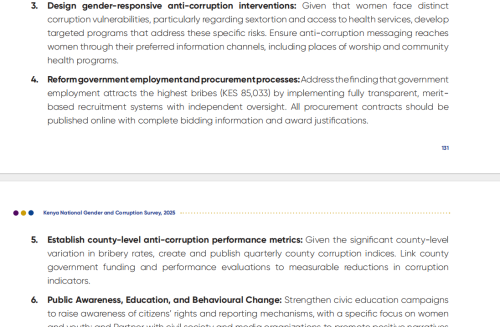
“Given that women face distinct corruption vulnerabilities, particularly regarding sextortion and access to health services, develop targeted programs that address these specific risks. Ensure anti-corruption messaging reaches women through their preferred information channels, including places of worship and community health programs,” reads the report in part.
Sextortion patterns and vulnerable groups
The survey identifies sextortion as a significant form of gendered corruption affecting women. Overall, 8.4 per cent of respondents reported indirect requests for sexual favours, with women at 9.3 per cent compared to 7.4 per cent for men. Direct requests stood at 2.1 per cent nationally, with women reporting 3.4 per cent compared to 0.8 per cent for men.
Among those affected, women accounted for 72.8 per cent of victims. Young people aged between 18 and 34 recorded the highest exposure, particularly those seeking employment, who accounted for 49.6 per cent of private sector sextortion cases.
The findings also show that private sector interactions were affected, including employment and medical services.
Higher prevalence was reported in Nairobi, Kajiado and Machakos counties, with the most affected groups being unemployed, self-employed and lower-income individuals, as well as those with primary and secondary education levels.
Low reporting and rising public concern
The report highlights low reporting levels, with 98.6 per cent of those who paid bribes not reporting the incidents. Only 1.4 per cent reported, with women accounting for 57.2 per cent of those cases. Among reported cases, 42.3 per cent indicated no action was taken.
Public perception of corruption has increased, with 74.2 per cent of respondents rating it as high in 2025, up from 67.6 per cent in 2024, while 65.8 per cent said corruption had increased over the past year. Only 14.6 per cent expressed confidence in government efforts to address the issue.
“Corruption is not gender neutral. Yet, for too long, anti-corruption strategies have been designed without the disaggregated data needed to fully capture this reality.” UNODC Regional Representative Ali Elbereir.
“Women face compounded disadvantages, as corruption restricts both their access to quality public services and their participation in public, economic, and political spheres.” Executive Summary of the survey.