Willis Otieno reprimands Sakaja over the state of basic services in Nairobi
By Kiprono Keileb, December 5, 2025Lawyer and political commentator Willis Otieno has launched a stinging attack on Nairobi Governor Johnson Sakaja, calling him out for turning the capital into a city of unfulfilled promises and worsening basic services.
In a statement posted on X on Friday, December 5, 2025, Otieno criticised the governor for failing to deliver on key pledges he made during the 2022 campaigns.
He argued that a governor who once pledged grand, transformative projects, among them a metro rail system, 17 special needs centres, a fully functional county blood bank, and 20 modern markets, should not, two years into office, still be grappling with the most basic duties of urban governance.
According to him, these ambitious commitments have remained largely theoretical, with even the simplest promises still unmet. He pointed out that essential services such as reliable water supply and public amenities like children’s playgrounds, which Sakaja proudly announced during his campaigns, remain unfulfilled to this day, further deepening public frustration over the widening gap between words and action.
“A whole Governor who pledged a metro rail, 17 special needs centres, a county blood bank, and 20 new markets can’t even keep basic toilets clean. Nairobi is dirtier, water is scarcer, and playgrounds remain fiction. The only thing he has decentralised successfully is chaos,” he said, adding in the statement.
Sideshows
Otieno went on to describe Nairobi under Sakaja as a place where promises exist more on slideshows than on the ground. He stated that Nairobi’s leadership is just a vibe instead of governance.
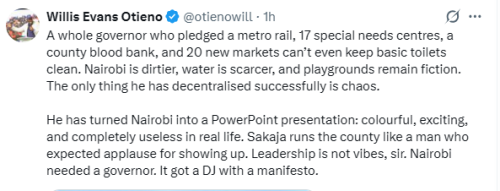
“He has turned Nairobi into a PowerPoint presentation: colourful, exciting, and completely useless in real life. Sakaja runs the county like a man who expected applause for showing up. Leadership is not vibes, sir. Nairobi needed a governor. It got a DJ with a manifesto,” he stated.
Governance analysts say these concerns have become more prominent as Nairobi heads into a new political cycle where performance, especially on basic urban services, is likely to influence voters more than past branding or national alliances.
As the debate intensifies, Governor Sakaja has continued to defend his administration, often blaming budget constraints and inherited structural inefficiencies. However, Otieno’s statement reflects a sentiment among Nairobians who feel that the gap between the governor’s ambitions and ground reality keeps widening.