Willis Otieno defends June 25 planned demonstrations amid anxiety
By Mustafa Juma, June 24, 2026Constitutional lawyer Willis Evans Otieno has defended the planned June 25 commemorative demonstrations, arguing that the right to assemble, protest and express dissent is a constitutional guarantee rather than a privilege granted by the state.
His remarks come amid heightened tension ahead of the nationwide commemorations expected to mark the second anniversary of the June 25, 2024, anti-Finance Bill protests, a watershed moment in Kenya’s recent political history that culminated in the storming of Parliament by demonstrators and forced the withdrawal of controversial tax proposals.
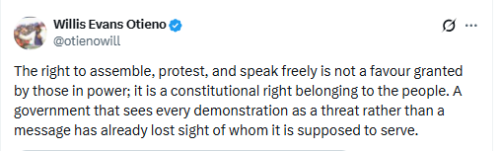
Taking to his official X account on Wednesday, June 24, 2026, the Safina deputy party leader noted that a government that sees every demonstration as a threat rather than a message has already lost sight.
“The right to assemble, protest, and speak freely is not a favour granted by those in power; it is a constitutional right belonging to the people,” Otieno stated.
“A government that sees every demonstration as a threat rather than a message has already lost sight of whom it is supposed to serve.”
Debate over June 25 commemorations
Otieno’s comments come as government officials, security agencies, activists, and political leaders continue to debate the significance and security implications of the planned demonstrations.
Police have repeatedly assured Kenyans that adequate security measures have been put in place ahead of the commemorations, while warning that criminal elements will not be allowed to infiltrate peaceful gatherings. Senior security officials have emphasised that while the Constitution guarantees the right to protest, law enforcement agencies will act against violence, looting and destruction of property.
The planned demonstrations are expected to take place in Nairobi and several other towns across the country, with organisers describing them as memorial events aimed at honouring young Kenyans who lost their lives during the 2024 protests and subsequent demonstrations.
Legacy of the Gen Z uprising
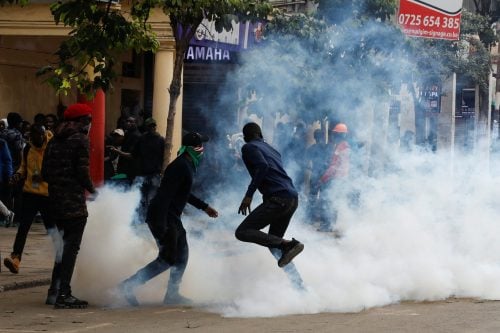
The June 25 commemorations draw their significance from the unprecedented Gen Z-led protests that erupted in 2024 against the Finance Bill.
What began as opposition to proposed tax increases evolved into a broader movement challenging governance, corruption, accountability, and the rising cost of living. Social media played a central role in mobilising thousands of young people who organised largely outside traditional political structures.
PHOTO/@channelafrica1/X
The demonstrations reached a dramatic climax on June 25, 2024, when protesters breached Parliament grounds as lawmakers debated the Finance Bill. The unrest forced President William Ruto to decline assent to the bill and announce spending cuts in response to mounting public pressure.
The events transformed June 25 into a symbolic date for many young Kenyans, representing both resistance against unpopular policies and demands for greater accountability from government institutions.
Calls for peaceful demonstrations
Despite widespread support for the commemorations among sections of civil society and youth groups, concerns have emerged over the possibility of violence and infiltration by criminal gangs.
Former Deputy President Rigathi Gachagua has appealed to the youths to reconsider participating in the planned June 25, 2026, demonstrations, citing fears of violence and loss of life.

Speaking from Wamunyoro on Tuesday, June 23, 2026, Gachagua claimed he had received intelligence reports indicating that criminal gangs would be deployed to infiltrate the protests and cause chaos in various parts of the country, including Nairobi, the Mount Kenya region, Kajiado and Narok counties.
Security agencies have warned against individuals seeking to exploit the demonstrations for criminal purposes, while several community organisations have urged participants to remain peaceful. Some groups have even expressed reservations about taking part, citing fears of unrest and the presence of criminal elements during previous demonstrations.
At the same time, activists, political leaders, and sections of the public continue to insist that peaceful assembly remains a fundamental democratic right protected under the Constitution.