Willis Otieno condemns demand for documentation before emergency treatment
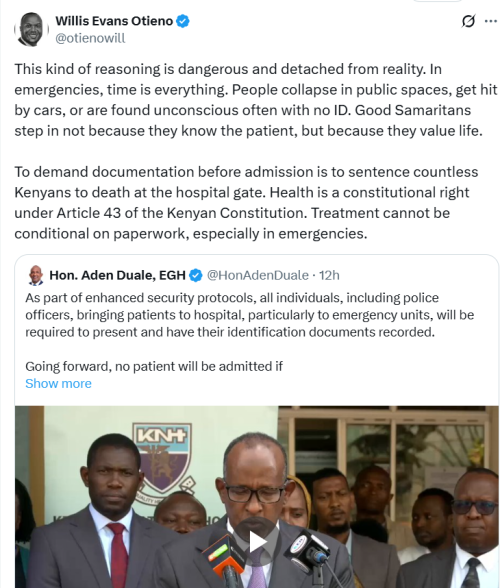
By Faith Lagat, July 29, 2025In a scathing critique of a new policy announced by Kenya’s Health Cabinet Secretary Aden Duale, lawyer and social commentator Willis Otieno has condemned the requirement for documentation before emergency treatment, calling it “dangerous and detached from reality.”
In his X post on July 29, 2025, Otieno complained that demanding documentation before admission is sentencing countless Kenyans to death at the hospital gate.
The remarks were made in response to Duale’s recent directive that all individuals bringing patients to the hospital—particularly in emergency units—must present and have their identification documents recorded.
Duale stated that “no patient will be admitted if dropped off by unidentified or anonymous persons,” citing concerns over patient safety, impersonation, abandonment, and criminal activities within health facilities. The policy, according to Duale, is intended to safeguard both patients and healthcare workers.
However, Otieno has challenged the practicality and morality of such a move, especially in critical situations where immediate care is essential.
Risk
Otieno warned that enforcing documentation requirements at the hospital gate could lead to unnecessary loss of lives. “This kind of reasoning is dangerous and detached from reality. In emergencies, time is everything. People collapse in public spaces, get hit by cars, or are found unconscious, often with no ID,” he said. “Good Samaritans step in not because they know the patient, but because they value life.”
He noted that requiring identification before admission delays crucial medical attention, placing lives at risk. “To demand documentation before admission is to sentence countless Kenyans to death at the hospital gate,” Otieno asserted, adding that the move could discourage bystanders from helping injured or unconscious individuals due to fear of bureaucratic complications.
Otieno’s remarks have drawn wide public attention and reignited debate on how far security protocols should go in healthcare settings, particularly where they intersect with matters of life and death.
Health rights
Citing the Kenyan Constitution, Otieno emphasised that health is not a privilege but a right. “Health is a constitutional right under Article 43 of the Kenyan Constitution. Treatment cannot be conditional on paperwork, especially in emergencies,” he said. His argument suggests that the new directive could be unconstitutional and a violation of patients’ rights.
The criticism adds pressure on the Ministry of Health to clarify or revise the policy, which many fear could have unintended consequences. As the conversation continues, the spotlight remains on whether Kenya’s healthcare system can strike a balance between security protocols and the urgent humanitarian demands of emergency medicine.
Otieno’s position underscores a fundamental question facing health policymakers: Should administrative procedures ever come before saving lives?