Willis Otieno accuses govt of selective enforcement on police neutrality
By Faith Lagat, August 1, 2025Political analyst and constitutional lawyer Willis Otieno has criticised the Kenyan government for what he termed as selective enforcement of police neutrality laws, accusing top officials of manipulating the police to serve partisan interests during the recent Saba Saba protests.
Taking to his X on August 1, 2025, Otieno accused the state of weaponising the National Police Service against citizens while hiding behind the law. He took direct aim at Interior Cabinet Secretary Kipchumba Murkomen, accusing him of double standards.
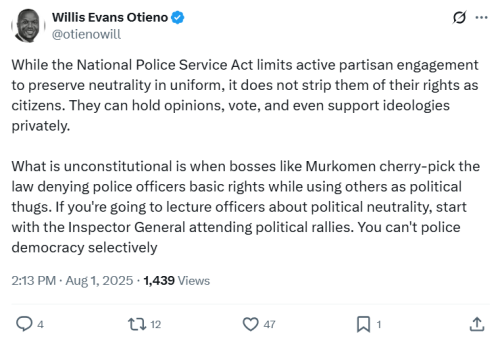
“While the National Police Service Act limits active partisan engagement to preserve neutrality in uniform, it does not strip them of their rights as citizens. They can hold opinions, vote, and even support ideologies privately,” Otieno wrote.
He accused Murkomen of denying junior officers their constitutional rights while turning a blind eye to political interference by senior officers. “What is unconstitutional is when bosses like Murkomen cherry-pick the law—denying police officers basic rights while using others as political thugs.”
“What is unconstitutional is when bosses like Murkomen cherry-pick the law, denying police officers basic rights while using others as political thugs. If you’re going to lecture officers about political neutrality, start with the Inspector General attending political rallies. You can’t police democracy selectively,” read the post.
Calls Out IG Over Political Rallies
Otieno specifically questioned the neutrality of Inspector General Kanja, citing his presence at political rallies. “If you’re going to lecture officers about political neutrality, start with the Inspector General attending political rallies,” he said. “You can’t police democracy selectively.”
His remarks come in the wake of the July 7 Saba Saba demonstrations that marked the 35th anniversary of Kenya’s multi-party democracy movement. The protests turned deadly, with reports indicating at least 11 deaths and over 500 arrests, alongside claims of police using live ammunition in residential areas.
“The right to picket is in the Constitution. They blocked the CBD. What were they doing in the residential areas? Why were they shooting in people’s homes?” Otieno posed. He warned that the ongoing suppression was part of a broader strategy to silence dissent and intimidate Gen Z protesters, who have been central to recent demonstrations.
Murkomen’s remarks spark further debate
Meanwhile, speaking at a church service in Marakwet West on July 27, Murkomen condemned police corruption, particularly extortion targeting boda boda riders. “Do not take bribes on the roads because it is bringing shame to the government and giving the police a bad image,” he said.
Otieno, however, dismissed Murkomen’s statements as hypocritical, arguing that failure to address political interference within the force undermines any genuine reform efforts.
As nationwide protests persist, the clash between Otieno’s push for accountability and government rhetoric continues to raise questions about the future of police independence and democratic space in Kenya.