Advertisement
Why leaders are jostling for post of regional chief
Monday 07th June, 2021 12:04 AM|
Eric Wainaina @EWainaina
Keen to play a national role in next year’s elections, many politicians are strategically positioning themselves as regional kingpins or spokespersons.
So stiff is the competition for the positions that even perceived political lightweights have not been left behind.
Cabinet secretaries, final term governors and other leaders eying running mate or Cabinet positions in the next government, are out to carve a niche on the national arena by being crowned regional or ethnic kingpins or declaring presidential bids.
And in some areas — such as the Mt Kenya region where President Uhuru Kenyatta has influenced politics for years, Rift Valley where Deputy President William Ruto is the head, Nyanza region where Raila Odinga is the de facto king and Ukambani where Wiper leader Kalonzo Musyoka holds sway — a new crop of politicians has emerged to disrupt status quo and serve as alternatives.
The same scenario applies in Western Kenya where a number of politicians are positioning themselves to replace Amani National Congress party leader Musalia Mudavadi as the point man while at the Coast, Mombasa Governor Hassan Joho who has been the de facto leader, is facing competition from fellow second-term governors.
Communities that have been without political kingpins such as the Maa following the deaths of former powerful ministers William ole Ntimama and George Saitoti, as well as the Gusii where late minister Semion Nyachae was an authority, new leaders are also competing to grab the mantle.
Macharia Munene, a professor of History and International Relations at the United States International University (USIU) said the competition for the position of regional kingpin is informed by the politicians’ need to survive or advance their 2022 ambitions.
“Some of the governors jostling for the positions are second-termers who want to be relevant after next year.
Even appearing like a leader of a village would be seen as a job by some of them. It also makes them attractive to designers of 2022 succession politics who may consider them in their plans,” the don told People Daily.
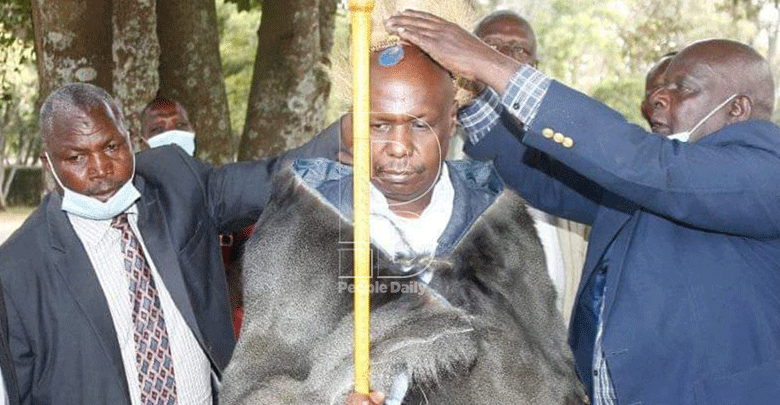
In Rift Valley, Baringo Senator Gideon Moi, in his bid to dethrone Ruto as the region’s leader, was recently crowned a Kalenjin elder in a controversial ritual performed by a faction of Talai elders.
Moi is also teaming up with other national leaders to build an alliance.
Last year Senator Moi, who has declared interest in the presidency had his family hand him his late father former President Daniel Moi’s symbolic leadership rungu to signify transfer of the mantle to him.
In Luo Nyanza where Raila has reigned supreme for decades, Migori governor Okoth Obado who gravitates towards DP Ruto’s camp, has revamped his former People’s Democratic Party, which he is popularising in the region.
Political base
Obado seems to be a man on a mission to succeed where others have failed in the past – edging out the ODM leader from the apex of the region’s politics.
The recent Building Bridges Initiative controversy involving Siaya Senator James Orengo was also linked to the battle to inherit Raila’s Nyanza constituency.
In the battle for the control of Ukambani region, governors Alfred Mutua (Machakos) and Kivutha Kibwana (Makueni), second timers who have declared their bid for the presidency and former Machakos senator Johnson Muthama, who has teamed up with Ruto, are keen to replace Kalonzo as the regional chief.
Mutua, was recently installed a Kamba elder by Thome wa Akamba, who tasked him, “with the responsibility of leading the Kamba nation” and so was Muthama who had hoped to use the recent Machakos by-election to test waters using a United Democratic Alliance candidate.
However, there is an agreement among pundits that though everyone has a right to eye the kingpin position, coronations or installation by elders may be inconsequential unless they have the support of the people.
“It is not something that is cooked somewhere over a drink. Neither can you wake up one morning and say that you want to be a leader.
You must command respect, authority and influence irrespective of whether you have a statutory position. Many of the contestants have not attained this,” Munene says.
Makueni lawmaker Dan Maanzo said though politicians are at liberty to be installed as regional kingpins, acquiring the title is a tedious and expensive process.
“This is something that is built over a very long time. It’s not something that is done within a day like some of these leaders want to imagine.
It’s a very expensive affair and what I can tell them is that they have a very long way to go,” Maanzo says, adding that being a political position, it also involves building a solid political base.
In Mt Kenya, where Uhuru is expected to exit next year after being at the helm of region’s politics since 2012, seven politicians are jostling for the position.
Bonchari contest
They include National Assembly Speaker Justin Muturi, who was recently controversially crowned the region’s spokesman, former presidential candidate Peter Kenneth, Agriculture minister Peter Munya, his predecessor Mwangi Kiunjuri, Murang’a Governor Mwangi wa Iria, Kirinyaga Governor Anne Waiguru and former Kiambu Governor William Kabogo.
“Central Kenya and Nyanza regions present a unique political landscape because their respective kingpins are at the tail end of their political careers and with no automatic heir apparent, these leaders are seeing a vacuum which power hates,” says Obuya Bagaka, a political scientist said.
However, like Munene, Bagaka cautions those investing in the positions that becoming regional kingpin is not a walk in the park.
“It is not just about being crowned. It has to be worked for and earned,” he observes.
“Joho became the political face of the Coast because he stood for the interests of the people to an extent of facing arrests. In Rift Valley, Ruto did not get it on a silver platter.
In fact, former President Moi fought him and he had to compete with other powerful politicians like Nicholas Biwott, Henry Kosgey and Franklin Bett. He fought his way to earn it,” he adds.
Bagaka says Uhuru took more than ten years to command influence in the Mt Kenya region.
In Western Kenya, former UNCTAD Secretary General Mukhisa Kituyi and Kakamega Governor Wycliffe Oparanya, both of whom have declared intention to run for the presidency, want to take the mantle from Mudavadi who is considered the region’s leader.
In the Maa community, Kajiado Governor Joseph ole Lenku, who made an entry into politics in 2017, was recently crowned a Maasai elder. Narok Senator Ledama ole Kina has also been jostling to be the leader of the community.
In the Coast region, governors Amason Kingi (Kilifi) and Salim Mvurya (Kwale) as well as Malindi MP Aisha Jumwa, a surrogate of Ruto’s, have been jostling to dislodge Joho as the region’s “Sultan”.
Joho, who also eyes the presidency, was in January crowned the national leader of the Muslim community while Kingi, who has been pushing for a regional party, was made Kaya spokesperson.
Interior CS Fred Matiang’i is in competition with Kisii Governor James Ogwae for the leadership of the Abagusii community.
The contest was on display in the recent Bonchari by-election where the CS backed Zebedeo Opore of Jubilee while Ongwae supported ODM’s Pavel Oimeke, who eventually won the seat.
Bagaka says that while it may not be easy uprooting incumbent kingpins, the changes in voter dynamics, especially among the young ones who do not resonate with conventional politics, may result in changes.
“The nature of the electorate is changing. Youth are not attracted by the politics of ethnic kingpins and some politicians, aware of this dynamic, are trying to endear themselves to the millennials,” he said.
But Kajiado South MP Katoo ole Metito argues that most politicians positioning themselves to be regional leaders only intend to use them to bargain for government positions and not to serve the people.
“This is not something that is attained by just being crowned by elders. It is nurtured over time and depends on how people perceive you, your attachment to them and what you have done for them,” the former Internal Security Minister said.
Author
Eric Wainaina
View all posts by Eric WainainaLatest News



Advertisement
More on News