Advertisement
Who was Félicien Kabuga who was on trial for Rwanda genocide?
Saturday 16th May, 2026 10:05 PM|

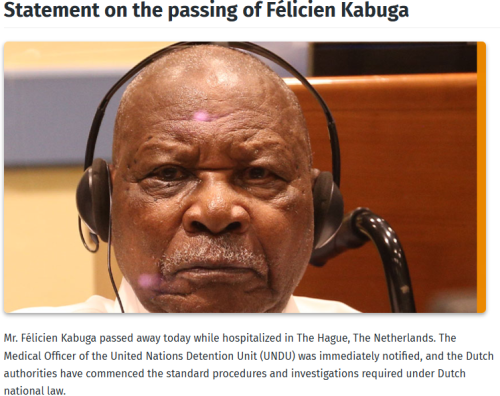
Félicien Kabuga was a wealthy Rwandan businessman accused of playing a central role in financing the 1994 genocide against the Tutsi in Rwanda.
For decades, Kabuga was one of the world’s most wanted fugitives, evading arrest for more than 25 years before he was captured in France in 2020.
His arrest reopened painful memories of the genocide that killed more than 800,000 people in just 100 days, with survivors viewing him as one of the key civilian figures behind one of Africa’s darkest chapters.
Kabuga’s early life
Kabuga was born in 1933 in northern Rwanda’s Byumba prefecture, now called the Gicumbi district, bordering Uganda.
He was once considered one of Rwanda’s richest men and was alleged to have used his fortune to fund extremist militias, import machetes used in the killings, and support the hate radio station RTLM, which broadcast propaganda that incited mass violence.
You Might Also Like



According to accounts of residents in Rwanda, Kabuga peddled items door-to-door and sold cigarettes and used clothes in a market in Byumba prefecture.
He later moved to Kigali, where he opened several shops. Kabuga owned a tea plantation, a mill, and a real estate business, locals say.
By 1994, he had accumulated a great deal of wealth. In 1993, as a rich businessman, he made connections with former President Juvenal Habyarimana’s family after marrying off his daughter to his eldest son.
Indictments
In August 1998, Kabuga was indicted by the now-defunct Tanzania-based International Criminal Tribunal for Rwanda (ICTR) and an international arrest warrant was issued for him in 1999.
According to the indictment, Kabuga was charged on 11 counts, including genocide, complicity in genocide, and direct and public incitement to commit genocide.
He was also accused of assassination as a crime against humanity, extermination as a crime against humanity, rape as a crime against humanity, persecutions on political, racial or religious grounds as crimes against humanity and war crimes.
“In his position of authority, Felicien Kabuga between April and June 1994 contributed to the Interahamwe’s killing and harming of persons identified as Tutsis by organizing meetings to raise funds to purchase arms,” the ICTR indictment reads in part.
Evading arrest
Kabuga’s wealth is believed to have helped him evade arrest for more than two decades, being able to roam to different countries.
On June 11, 2002, the United States launched a wide media campaign in Kenya aimed at capturing Kabuga.
In the same year the US offered a reward of up to Ksh600,000,000 for any information leading to the capture of Kabuga.
,
In December 2002, the US accused then-Kenyan National Security Permanent Secretary Zakayo Cheruiyot of offering refuge to Kabuga and of using governmental infrastructure to curtail his arrest.
In January 2003, Kabuga escaped arrest led by both the Kenyan police and the FBI in Nairobi.
In January 2003, a police informer and Journalist tasked to entrap Kabuga was found dead.
In August 2003, the United Nations Security Council urged all states, including Kenya, to cooperate more to find Kabuga and to bring him to justice.
In 2011, the ICTR organised forums to gather testimony for Kabuga’s eventual trial, to prevent loss of evidence in case some witnesses died before his arrest.
On August 1, 2012, Kabuga’s case was transferred to the International Residual Mechanism for Criminal Tribunals created by the UN in December 2010 to assume some functions of the ICTR after the end of its mandate.
In 2020 the long search comes to an end as Kabuga is arrested in France.
The French public prosecutor’s office and the police said Kabuga had been living under a false identity in a flat with the complicity of his children.
Kabuga’s death
After being eventually caught he was transferred to The Hague and charged with genocide, conspiracy to commit genocide, incitement to genocide, as well as crimes against humanity, including extermination and murder.
Six years after Kabuga’s arrest on the outskirts of Paris, Kabuga died in custody on May 16, 2026, at a hospital in The Hague, the Netherlands, at the age of 93.
Author
Latest News






Advertisement
More on News