WHO reveals new FGM statistics with over 4M girls at risk
By Cynthia Lodite, February 6, 2026The World Health Organisation has issued new statistics indicating an increased number of young women who are at risk of female genital mutilation.
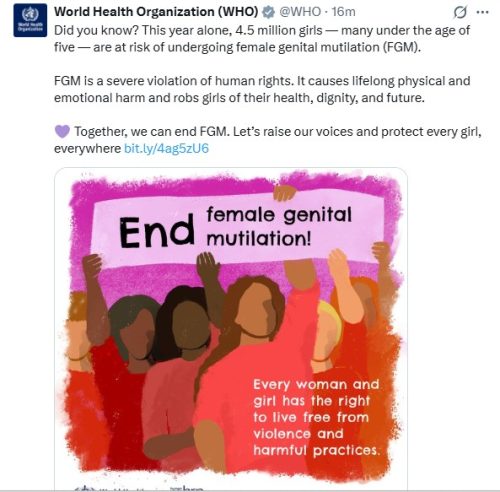
In a post on its official X account on Friday, February 6, 2026, WHO explained that the findings indicate that in 2026 at least 4.5 million girls will be at risk of FGM.
Among the 4.5 million girls, the WHO says many are under the age of five.
“Did you know? This year alone, 4.5 million girls — many under the age of five — are at risk of undergoing female genital mutilation (FGM). FGM is a severe violation of human rights. It causes lifelong physical and emotional harm and robs girls of their health, dignity, and future,” WHO said.
Statistics further reveal that over 230 million girls and women today are living with the consequences of FGM globally.
Worth noting, female genital mutilation (FGM) comprises all procedures that involve partial or total removal of the external female genitalia or other injury to the female genital organs for non-medical reasons.
The practice has no health benefits for girls and women and can result in severe bleeding and problems urinating, and later cysts, menstrual difficulties, and infections, as well as complications in childbirth and an increased risk of newborn deaths.
The practice of FGM is recognized internationally as a violation of the human rights of girls and women. It reflects deep-rooted inequality between the sexes and constitutes an extreme form of discrimination against girls and women.
It is nearly always carried out on minors and is a violation of the rights of children. The practice also violates a person’s right to health, security and physical integrity; the right to be free from torture and cruel, inhuman or degrading treatment; and the right to life, in instances when the procedure results in death.
In several settings, there is evidence suggesting greater involvement of health workers in performing FGM due to the belief that the procedure is safer when medicalized.
Types of FGM
Female genital mutilation is classified into 4 major types:
Type 1: This is the partial or total removal of the clitoral glans (the external and visible part of the clitoris, which is a sensitive part of the female genitals), and/or the prepuce/clitoral hood (the fold of skin surrounding the clitoral glans).
Type 2: This is the partial or total removal of the clitoral glans and the labia minora (the inner folds of the vulva), with or without removal of the labia majora (the outer folds of skin of the vulva).
Type 3: Also known as infibulation, this is the narrowing of the vaginal opening through the creation of a covering seal. The seal is formed by cutting and repositioning the labia minora, or labia majora, sometimes through stitching, with or without removal of the clitoral prepuce/clitoral hood and glans.
Type 4: This includes all other harmful procedures to the female genitalia for non-medical purposes, e.g., pricking, piercing, incising, scraping and cauterizing the genital area.