WHO credits vaccines with saving over 150 million lives worldwide
By Cynthia Lodite, April 7, 2026The World Health Organisation (WHO) has shared details on how millions of lives have been saved through science in protecting and improving the health status through vaccinations.
In a statement on Teusday April 7,2026, WHO noted that since the inception of vaccines in 1974, atleast one hundered and fifty million lives have been saved.
At the same time, the WHO has revealed that the use of science in vaccines is one of humanity’s most powerful tools for protecting and improving health
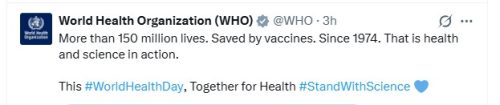
“More than 150 million lives. Saved by vaccines. Since 1974. That is health and science in action,” WHO noted.
Sience behind Vaccines
The World Health Organisation (WHO) has called on people everywhere to renew their commitment to working together and supporting science as the twin engines driving better health, under the World Health Day 2026 theme: “Together for health. Stand with science.”
The campaign marks the anniversary of the WHO’s founding on 7 April 1948, launching a year-long public health campaign.
WHO further explained that human health has been profoundly transformed over the past century, largely due to scientific progress and international collaboration. The global maternal mortality rate has fallen by more than 40% since 2000, and deaths among children under five have been reduced by over 50%.
Likewise, advances in technology, scientific knowledge and skills, and collaboration between different disciplines, sectors and countries continue to turn once-life-threatening health challenges – such as elevated blood pressure, cancer diagnoses or HIV infection – into manageable health issues, extending and improving lives worldwide.
Yet, WHO notes that health threats continue to grow, fuelled by climate impacts, environmental degradation, geopolitical tensions and shifting demographics.
These challenges include persistent diseases and strained health systems as well as emerging diseases with epidemic or pandemic potential.
Across the globe, thousands of scientists – together with organisations such as WHO – are accelerating research and developing policies, tools and innovations needed to protect communities today and safeguard the health of future generations.
“Science is one of humanity’s most powerful tools for protecting and improving health,” said Tedros Adhanom Ghebreyesus, Director-General of the World Health Organization. “People in every country live longer and healthier lives on average today than their ancestors did, thanks to the power of science. Vaccines, penicillin, germ theory, MRI machines and the mapping of the human genome are just some of the achievements that science has delivered that have saved lives and transformed health for billions of people.”