Advertisement
WhatsApp confirms chats remain private despite recent claims
Friday 30th January, 2026 11:09 AM|

WhatsApp has denied citations that its staff or contractors can access users’ encrypted messages, calling recent claims false and technically impossible.
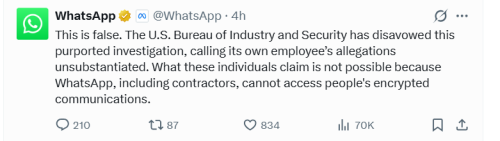
In a statement posted on X on January 30, 2026, the company addressed a viral post claiming former Meta contractors had revealed the platform could read private chats.
“This is false. The U.S. Bureau of Industry and Security has disavowed this purported investigation, calling its own employees’ allegations unsubstantiated,” the company said.
“What these individuals claim is not possible because WhatsApp, including contractors, cannot access people’s encrypted communications.”
Assertions spark privacy debate
You Might Also Like



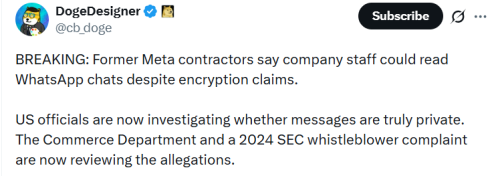
The controversy began when an X post by user Doge Designer claimed that former Meta contractors say company staff could read WhatsApp chats despite encryption claims and that US officials were investigating whether messages are truly private.
“Former Meta contractors say company staff could read WhatsApp chats despite encryption claims. US officials are now investigating whether messages are truly private. The Commerce Department and a 2024 SEC whistleblower complaint are now reviewing the allegations,” Doge claimed.
WhatsApp quickly clarified that no such investigation exists and that the technical claims are unfounded.
The assertions follow comments by Telegram founder Pavel Durov, who on January 26, 2026, questioned WhatsApp’s security, claiming potential weaknesses in how the platform deploys encryption.
“You’d have to be brain-dead to believe WhatsApp is secure in 2026. When we analysed how WhatsApp implemented its ‘encryption’, we found multiple attack vectors,” Durov wrote.
WhatsApp defends encryption
WhatsApp uses end-to-end encryption based on the Signal Protocol, which experts widely recognise as robust. Only the sender and recipient hold the keys needed to decrypt messages, meaning neither WhatsApp nor Meta can access content.
Cybersecurity specialists note that real-world privacy can be affected by factors outside the protocol, such as unencrypted cloud backups, compromised devices, or metadata collection, but these do not indicate weaknesses in WhatsApp’s encryption itself.
WhatsApp also noted that all messages on its platform are private and secured using the open-source Signal Protocol.
The company explained that encryption takes place directly on users’ devices, ensuring that messages are encrypted before leaving the device. Only the intended recipient holds the keys needed to decrypt the messages, and these keys are never accessible to WhatsApp or its parent company, Meta.
The platform emphasised that any claims suggesting otherwise are false, reaffirming its commitment to protecting user privacy.
Author
Latest News







Advertisement
More on News