Advertisement
‘Water for All’ target trickles amid flow of scarcity
Wednesday 06th April, 2022 12:18 AM|
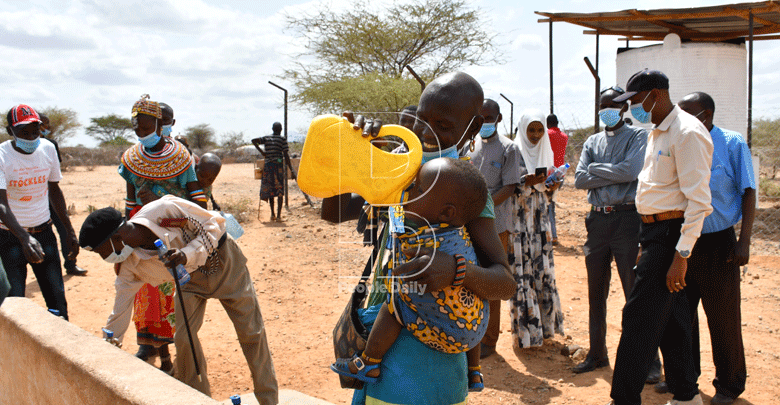
Every March 22, the international community observes World Water Day. Principally, the day, marked last week, focuses on raising awareness about the importance of water and educating people to conserve the precious commodity.
This year’s theme, ‘Groundwater, making the invisibility visible’, resonates with the United Nations’ efforts to accelerate increased water coverage as outlined in Sustainable Development Goal 6, which aspires to ensure water and sanitation for all by the year 2030.
Our Constitution, under the Bill of Rights, affirms access to “clean and safe water in adequate quantities” for all Kenyans as a constitutional right. This commitment is amplified in Kenya’s flagship national economic blueprint, Vision 2030, which echoes the ‘Water for All’ by 2030 call.
Constitutional and policy declarations notwithstanding, the UN classifies Kenya as a water-scarce country, explained by its low supply of renewable freshwater estimated at 670 cubic meters per capita per year against the global recommendation of 1000 cubic meters per capita per year.
Studies indicate these estimates, a derivative of the Water Crowding Index (a model which rates water resources based on human population within an area), may likely not be sufficient in depicting the actual levels of the country’s water scarcity.
This could be attributed to the model’s approach that disregards temporal variability and some vital drivers of water demand related to economic growth such as ecological systems, agricultural and industrial usages.
In view of these factors, it is feared that Kenya may likely graduate negatively to an absolute water-scarce country with an estimated below 500 cubic meters per capita per year of renewable fresh water.
Kenya undertook water sector reforms in 2000s, ostensibly to improve water services provision that witnessed the enactment of the Water Act 2002 and repealed the Water Act 2016 to correspond with the new water sector constitutional demands.
The Act affirms the broad water sector’s prime responsibilities to protect, conserve, manage and increase access to clean and safe water for socio-economic development.
Although water services provision is a devolved function, protection and conservation of the catchment critical for sustainable flow of fresh water to feed the production chain is the responsibility of the national government.
The Water Services Sector Regulatory Board depicts unsatisfactory levels of water coverage over the years in terms of the expanded installed water network. Moreover, the hours of constancy of water supplied even in the covered areas is unacceptable.
In the same breath, the country continues to register very high non-revenue water. Since the reforms took effect, increased government funding and bilateral support to the water sector has been witnessed, with a bulk of the resources channeled to water and sewerage infrastructure development.
This is a small fraction of the national water sector budget cake of which 17% is directed to water resources conservation and protection. Yet indications point to increased scarcity of freshwater and rapid depletion of ground water aquifers, a situation likely to be exacerbated by the global impact of climate change.
While concerted efforts are geared toward inclusive water coverage to attain and sustain this goal, catchment conservation and protection must be given priority. A structured engagement of multi-agency participation is desirable.
The national and county governments, civil society, communities living within the catchment, water services providers and research-based organisations should cascade to complement the efforts of the Water Resources Management Authority and the Kenya Water Towers Agency to achieve the ‘Water for All’ goal.
– The writer is a monitoring and evaluation practitioner — [email protected]
Author
PD columnist
View all posts by PD columnistLatest News








Advertisement