Wasike Khayenje, blind pit latrine digger who sees deep
By People Reporter, March 13, 2020David Musundi
When we met Francis Wasike Khayenje, he had just arrived home for lunch and was perched on a stool talking to his four-year-old granddaughter.
The first thing that strikes you about Khayenje from Cheliminyi village in Sitikho ward, Bungoma county, is the fact that he is blind.
But what will leave you dumbfounded about the 63-year-old well-built man is what he does for a living.
After lunch, Khayenje, who became blind at the age of 26, takes us to where he has been working since 6am.
He digs latrine pits for a living and the pit he has been working on since the crack of dawn is so deep it is difficult to see the bottom.
However, he maneuvers his way effortlessly into the hole and start digging some more.
He has done this job for close to four decades, gaining precision and dexterity.
“I am hoping to continue working until my granddaughter is 15 years old so that I can rest,” he says, moments after making his way out of the pit to speak to us.
Khayenje, whose parents Emily Nasike and Jafred Osama died when he was still young, says he suffered an eye disease that was not detected early.
“I was referred to Kakamega, Mugumu and Sabatia hospitals for further diagnosis, but because I had no means to raise money for more specialised treatment, I lost my sight,” recalls the man who dropped out of school in Standard Three and has 10 siblings.
He recalls having left his home for work in Nzoia Sugar Company between 1976 and 1979 as a weeder before joining Chemosit Estate as a tea picker for five months and left when his eyesight completely failed him.
Refuse to pay
“I couldn’t continue working because of the pain. I went to Kakamega, Mugumu and then Sabatia hospitals where eye specialists said they could not do anything apart from giving me a white cane,’’ he says.
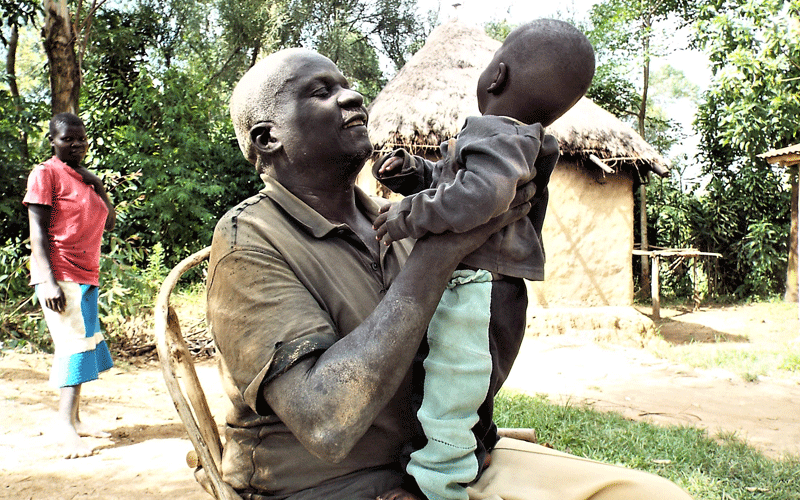
Photo/PD/ JIMMY GITAKA
He then resorted to digging latrine pits to fend for his wife and six children. His customers include schools, boda boda riders, teachers, sugar cane farmers and bicycle repairers in Sitikho location.
Khayenje, who mostly charges Sh150 per foot dug, says he faces challenges of non-payment by some clients upon completion of the work.
“Some people do not pay the whole amount after I finish my work. Others refuse to pay and keep tossing me around. Some pay after mounting pressure on them. We are all struggling to live meaningful lives,” he says.
After the day’s work, Khayenje returns home at 5pm to spend time with his family. He says he has married thrice since 1980s. He separated with the first wife while the second one died.
“I had to pay two cows (in 1977) according to the Bukusu customary law. That is what I could afford but the marriage hit the rocks and we parted ways,” he says of his first marriage, from which hehad a son.
Khayenje has fond memories of his second marriage to Jane Nafula who he married in 1983.
Treated early
His present wife, Alice Juma, 55, says Khayenje, whom she met at a church service in 1980, before he turned blind is an exemplary man.
“My husband is caring and hardworking, even with his condition he still struggles and fends for us,” she says.
One of Khayenje’s greatest wish is to enroll his children in tertiary institutions of learning, which has so far been an uphill task owing to lack of means.
“If my children could have attained better education, they could have helped me but now, at 63 and with my condition, the future looks bleak for me,” says Khayenje, whose wife sells second hand clothes.
Dr Abraham Kiplimo, an eye specialist at Cherangany Nursing Home, says Khayenje’s condition is irreversible, because it was not treated early.
Kiplimo says the causes of blindness differ according to the socioeconomic condition of where one lives. In third-world countries where 90 per cent of the world’s visually impaired population lives, the principal causes are infections, cataracts, glaucoma, injury and inability to obtain glasses.
Other causes include Vitamin A deficiency, retinopathy of prematurity, blood vessel disease involving the retina or optic nerve, including stroke.
“The treatment of visual impairment or blindness depends on the cause. In some cases, merely prescribing and giving glasses will alleviate the problem,’’ he says.
He adds that for those who are blind from cataracts, cataract surgery would, in most cases, restore their sight.