Advertisement
TVET curriculum council warns public against fake assessment materials
Wednesday 25th March, 2026 01:45 PM|

The TVET Curriculum Development, Assessment and Certification Council (TVET CDACC) has issued a public notice cautioning Kenyans against the purchase and circulation of fraudulent assessment materials, as the March/April 2026 Competency-Based Education and Training (CBET) assessments continue nationwide.
In a statement released under its legal mandate provided by the TVET Act No. 29 of 2013, the council confirmed that the ongoing assessments, which began on March 23, 2026, will run until April 14, 2026, across accredited institutions in Kenya. However, the council raised alarm over the emergence of individuals and online platforms claiming to sell legitimate assessment tools.
“The Council strongly cautions members of the public, trainers, candidates and trainees against purchasing, possessing or disseminating any purported assessment materials from unauthorised sources,” the notice stated.
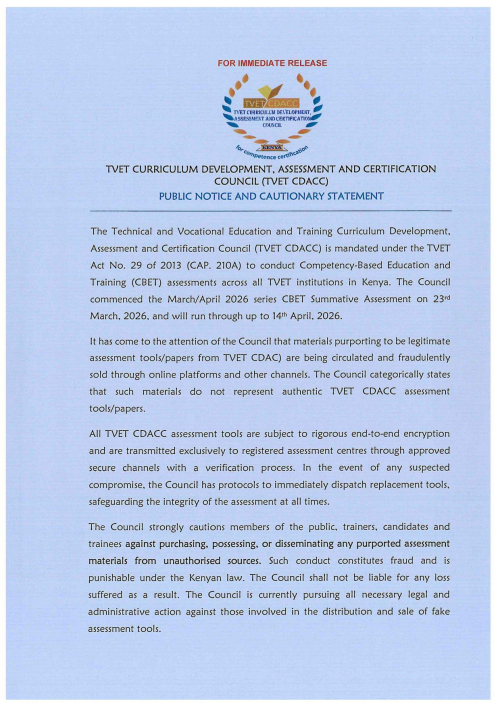
TVET CDACC categorically dismissed such materials as fake, emphasising that all official assessment tools are securely developed, encrypted, and transmitted only to registered assessment centres through verified channels. The Council further noted that any breach triggers immediate countermeasures, including the dispatch of replacement tools to safeguard the integrity of the examination process.
You Might Also Like



The agency also clarified that it will not be held liable for any losses incurred by individuals who engage with these illegal materials. It added that it is actively pursuing legal and administrative action against those involved in the distribution and sale of fake assessment papers.

To ensure transparency and authenticity, the Council urged the public to rely solely on its official communication channels, including its website and verified social media platforms. Any information circulating outside these platforms should be treated with caution and verified before use.
Members of the public have also been encouraged to report any cases of suspected fraud or solicitation of fake assessment materials through official TVET CDACC channels.
The council further reaffirmed the council’s commitment to maintaining credibility and integrity in the delivery of CBET assessments, underscoring the importance of upholding standards in Kenya’s technical and vocational education sector.
Author
Latest News







Advertisement
More on News