Treasury PS pushes payroll, pension digitisation in IBEC reform agenda
By Faith Lagat, September 29, 2025Treasury Principal Secretary Chris Kiptoo has noted that the Intergovernmental Budget and Economic Council (IBEC) is aimed at pushing for greater transparency with e-procurement and financial reforms in Kenya’s public sector.
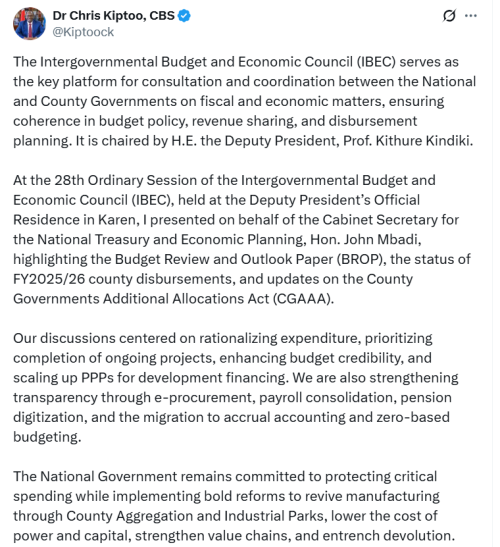
Kiptoo, while attending the IBEC during the 28th Ordinary Session on September 29, 2025, presented updates on the Budget Review and Outlook Paper (BROP), FY2025/26 county disbursements, and the County Governments Additional Allocations Act (CGAAA).
“We are also strengthening transparency through e-procurement, payroll consolidation, pension digitisation, and the migration to accrual accounting and zero-based budgeting,” he noted.
He said the council focused on coordinating fiscal strategies between the National and County Governments and improving oversight of public spending.
He noted that key discussions included rationalising expenditure, prioritising completion of ongoing projects, and strengthening financial systems through e-procurement, payroll consolidation, pension digitisation, and the adoption of accrual accounting and zero-based budgeting, aiming to make public finance management more transparent and efficient.
“Discussions centred on rationalising expenditure, prioritising completion of ongoing projects, enhancing budget credibility, and scaling up public-private partnerships (PPPs) for development financing. Kiptoo added.”
Strategic financial management and reforms
Kiptoo highlighted IBEC’s role as a key platform for coordination between the National and County Governments.
“The Intergovernmental Budget and Economic Council (IBEC) serves as the key platform for consultation and coordination between the National and County Governments on fiscal and economic matters, ensuring coherence in budget policy, revenue sharing, and disbursement planning. It is chaired by H.E. the Deputy President, Prof. Kithure Kindiki,” he said.
Economic growth
Kiptoo further outlined measures to support economic recovery and devolution.
“The National Government remains committed to protecting critical spending while implementing bold reforms to revive manufacturing through County Aggregation and Industrial Parks, lower the cost of power and capital, strengthen value chains, and entrench devolution. These measures will sustain macroeconomic stability, empower counties to deliver quality services, and unlock new opportunities for job creation and business growth,” he said.
The reforms align with President William Ruto’s stance on digital procurement, aimed at eliminating corruption and ensuring citizens get value for taxes.
Ruto stated on September 11, 2025, “For the avoidance of doubt, we are not going back on e-procurement, because we want transparency, we want citizens to get value for what they pay as tax, that is how we will eliminate corruption, and that is how we are going to save public money.”
Health Cabinet Secretary Aden Duale emphasised the system’s importance on September 12, noting, “The government loses up to 40 per cent of resources in the procurement of public services due to corruption and pilferage. To put an end to this misappropriation and embezzlement of funds, we are firmly committed to adopting e-procurement with no turning back.”
Linking fiscal reforms to development projects
The Electronic Government Procurement (e-GP) system, launched in April 2025, integrates planning to payments across state and county entities, with 87 per cent of corporations registered.
Ruto also announced new investments, including Ksh30 billion for 15,000 housing units in Kisii, Ksh2.5 billion for student hostels, and Ksh16 billion for 7,000 housing units and markets in Nyamira, reinforcing the connection between fiscal reforms and economic development.