Advertisement
Transparency International highlights People’s Audit to expose Kenya’s hidden debt crisis
Monday 08th December, 2025 01:29 PM|

Transparency International Kenya (TI-Kenya) has highlighted the People’s Audit initiative, urging citizens to demand transparency in public borrowing and to confront the cycle of debt and corruption that has put the country on the brink of a fiscal crisis.
Speaking at the People’s Audit launch on December 8, 2025, Sheila Masinde, Executive Director of Transparency International Kenya, reminded citizens that Kenya remains trapped in a cycle of debt and corruption driven by elite interests, opaque borrowing, and weakened oversight institutions. Yet, she said, citizens hold the true power.
“Hidden loans, weakened oversight, and a cycle of economic plunder have pushed Kenya to the edge. The People’s Audit is our turning point, a collective call to demand transparency, protect public finance, and take our country back. We can not fix Kenya by ignoring the truth,” Masinde stated.
Citizen-led diagnosis of public finances
Masinde emphasised the importance of citizens taking an active role in evaluating Kenya’s fiscal health. “If leaders can ask the IMF to diagnose Kenya, then we as citizens must diagnose ourselves too. The People’s Audit is our X-ray, exposing hunger, rising costs, youth unemployment, a broken education system, and debt risks. We know what ails us, and we’re saying it plainly.”
You Might Also Like



She added, “There has been a history of loans being taken off the books, institutions undermined, and citizens shut out. The People’s Audit centres our voice and insists: every report, every shilling, every decision must be made public.”
Rising debt and the need for reform
The launch comes as the World Bank’s Public Finance Review for Kenya warns that public debt now stands at nearly 68 per cent of GDP, with debt servicing consuming over a third of government revenue. The report notes that fiscal challenges are tied to broader development issues, including stagnating productivity, falling real wages, and weak job creation.
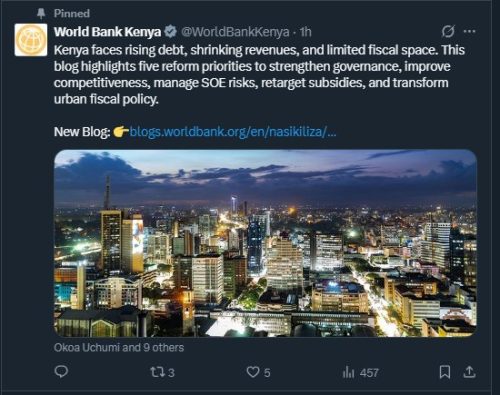
The World Bank recommends five priority reforms: strengthening governance and anti-corruption measures, creating a competitive private sector, reducing fiscal risks from state-owned enterprises, retargeting subsidies, and transforming urban fiscal policy. Economists say these reforms could reduce the debt-to-GDP ratio to about 44 per cent by 2035, boost growth, recover real wages, and shift employment to higher-productivity sectors.
“A narrowing window,” the report warns, citing the June 2024 Finance Bill protests as evidence of public demand for accountability. “Without reform, Kenya risks deepening its debt and alienating a generation. With it, the nation can chart a more inclusive and hopeful path.”
Author
Latest News






Advertisement
More on News