Society of Saint Pius X defends its position after Nairobi Archdiocese warning over Vatican decree
By Kenneth Mwenda, July 12, 2026The Society of Saint Pius X (SSPX) in Kenya has defended its ministry and urged Catholics attending its Holy Cross Church and Priory in Nairobi to remain calm after the Catholic Archdiocese of Nairobi warned the faithful against participating in the society’s activities.
The exchange follows a Vatican decree issued after four SSPX bishops were consecrated in Switzerland on July 1, 2026, without a pontifical mandate from Pope Leo XIV. The Holy See described the consecrations as an act “of a schismatic nature”, prompting Archbishop Philip Anyolo to issue a pastoral warning to Catholics in Nairobi and prompting SSPX Kenya to publish a detailed response.
The dispute has once again highlighted a disagreement that has existed for decades between the Vatican and the traditionalist society over Church authority, the reforms of the Second Vatican Council, and the role of the Pope in appointing bishops.
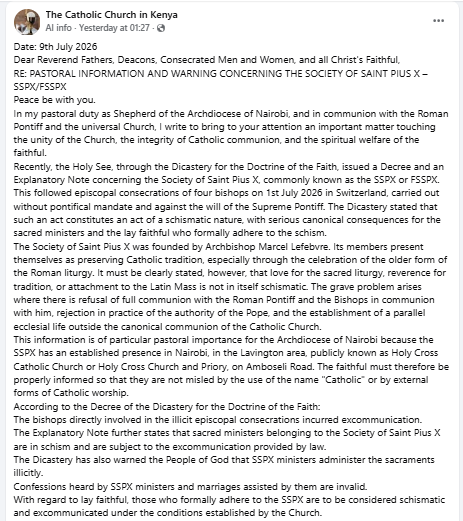
In his pastoral letter dated July 9, 2026, Archbishop Anyolo said his responsibility was to protect the unity of the Church, the integrity of Catholic communion, and the spiritual welfare of the faithful.
He explained that the Vatican’s Dicastery for the Doctrine of the Faith had acted after four bishops were consecrated without pontifical mandate and against the will of the Supreme Pontiff.
According to the Archbishop, the issue is not the celebration of the Traditional Latin Mass itself.
“The Society of Saint Pius X was founded by Archbishop Marcel Lefebvre. Its members present themselves as preserving Catholic tradition, especially through the celebration of the older form of the Roman liturgy,” Anyolo wrote.
“It must be clearly stated, however, that love for the sacred liturgy, reverence for tradition, or attachment to the Latin Mass is not in itself schismatic. The grave problem arises where there is refusal of full communion with the Roman Pontiff and the Bishops in communion with him, rejection in practice of the authority of the Pope, and the establishment of a parallel ecclesial life outside the canonical communion of the Catholic Church.”
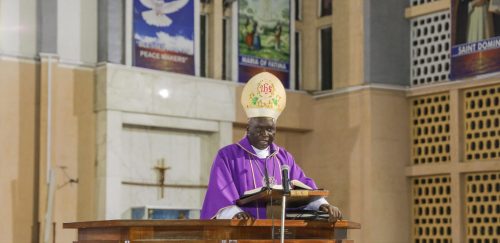
The Archbishop said the matter was especially important because the SSPX operates Holy Cross Church and Priory on Amboseli Road in Nairobi’s Lavington area.
“The faithful must therefore be properly informed so that they are not misled by the use of the name ‘Catholic’ or by external forms of Catholic worship,” he said.
Citing the Vatican decree, Anyolo said the bishops involved in the consecrations had incurred excommunication and added that SSPX clergy were considered to be in schism. He further stated that SSPX ministers administer the sacraments illicitly and warned that confessions heard by SSPX ministers and marriages assisted by them are invalid.
He also cautioned that Catholics who formally adhere to the SSPX could face canonical consequences under Church law.
For that reason, the Archbishop urged Catholics to remain in communion with Pope Leo XIV and bishops recognised by the Holy See.
“The faithful are not to adhere to the SSPX, promote its activities, or participate in its celebrations and apostolates,” he directed.
He instructed priests and deacons in the Archdiocese of Nairobi not to concelebrate with SSPX clergy, invite them to minister in Catholic parishes or institutions, or give the impression that their ministry has diocesan approval.
However, Anyolo stressed that the Church’s response should remain pastoral rather than hostile.
“At the same time, this circular is not an invitation to hostility, insults, or contempt. The Church remains a mother,” he said.
He invited priests wishing to leave the SSPX and accept the teachings of the Second Vatican Council to report to the Archbishop’s Office for assistance in returning to full ecclesial communion. Lay faithful who had attended SSPX activities were advised to seek guidance through their parish priests.
SSPX defends its position
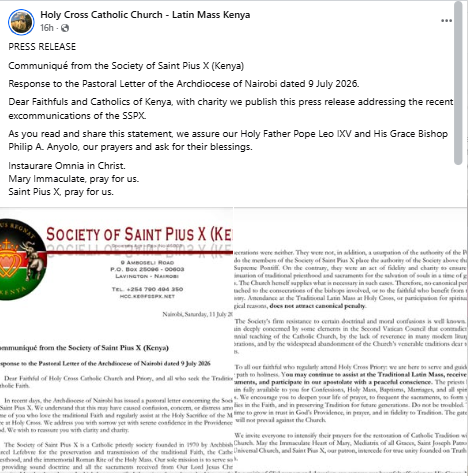
Hours after the pastoral letter, SSPX Kenya issued its own communiqué signed by Prior Rev. Fr. Pierre Champroux.
The society acknowledged that Archbishop Anyolo’s letter may have unsettled worshippers attending Holy Cross Church.
“We understand that this may have caused confusion, concern, or distress among some of you who love the traditional Faith and regularly assist at the Holy Sacrifice of the Mass here at Holy Cross,” Fr Champroux wrote.
“We wish to reassure you with clarity and charity.”
The SSPX described itself as a Catholic priestly society founded in 1970 by Archbishop Marcel Lefebvre to preserve the traditional Catholic faith, priesthood and Roman Rite.
“We are not a parallel Church. We remain fully Catholic and attached to the See of Peter and to his successor, Pope Leo XIV,” the communiqué stated.
The society rejected the Vatican’s penalties, saying they were “objectively unjust and invalid” and arguing that the July 1 consecrations were carried out because of what it described as a state of necessity within the Church.
“Regarding the recent Decree from the Holy See and the excommunication mentioned in the pastoral letter: we hold, as the Society has consistently maintained, that these penalties are objectively unjust and invalid. They do not correspond to the true state of necessity in which the Church finds herself today, nor do they invalidate the sacraments we administer according to the traditional rites.”
Fr. Champroux cited Canon 1323 of the Code of Canon Law, arguing that no penalty applies when a person acts out of necessity to avoid grave harm.
According to the communiqué, the consecrations “were performed out of grave duty for the continuation of the traditional priesthood amid the ongoing crisis.”
The SSPX also rejected the accusation of schism.
“We do not accept the label of schism. We do not have any spirit of bitterness or rebellion. Our only desire is to remain faithful to Our Lord Jesus Christ and his only Church.”
The society said it continued to pray daily for Pope Leo XIV and Archbishop Anyolo during Mass and assured Catholics attending Holy Cross Church that they could continue receiving the sacraments “with a peaceful conscience.”

Origins of the dispute
The disagreement has its roots in the history of the SSPX.
Archbishop Marcel Lefebvre founded the society in 1970 in Écône, Switzerland. It initially received canonical approval from Bishop François Charrière of the Diocese of Lausanne, Geneva and Fribourg as a pious union for six years. During that period, the society operated with full canonical recognition while training priests in the traditional liturgy.
Relations with Rome later deteriorated after Lefebvre opposed aspects of the Second Vatican Council, including liturgical reforms.
In 1975, the local bishop, with the approval of the Holy See, suppressed the SSPX. Lefebvre rejected the decision and continued operating the society.
A year later, he ordained priests without authorisation and was suspended from exercising priestly ministry.
The defining moment came in 1988 when Lefebvre consecrated four bishops without papal approval despite ongoing negotiations with the Vatican.
Under Catholic canon law, no bishop may consecrate another bishop without a pontifical mandate from the Pope. The rule exists to preserve unity within the Church and ensure that bishops remain in communion with the successor of St Peter.
The Vatican declared the 1988 consecrations a schismatic act. Lefebvre and the four bishops incurred latae sententiae excommunication, meaning the penalty took effect automatically when the act was committed.
Although Pope Benedict XVI lifted the excommunications of the surviving bishops in 2009 as part of reconciliation efforts, the SSPX itself was never granted full canonical status. Dialogue between Rome and the society has continued over the years without resolving their differences.
The latest dispute follows the same central issue. The Vatican maintains that consecrating bishops without papal approval directly challenges the Pope’s authority. The SSPX insists extraordinary circumstances justified its actions and argues that it remains Catholic despite rejecting the Vatican’s assessment.