Advertisement
Senators raise alarm over underfunded child protection and GBV services
Friday 27th March, 2026 05:56 PM|

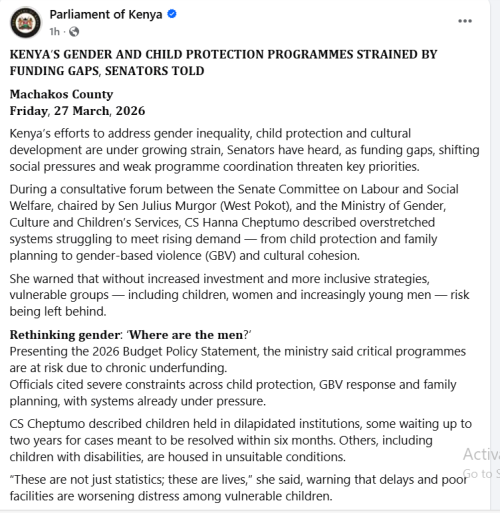
Senators have warned that chronic underfunding of child protection and gender-based violence (GBV) response services is stretching Kenya’s social welfare systems and putting vulnerable populations at risk.
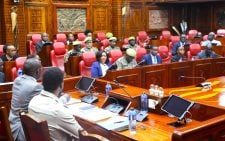
During a consultative forum in Machakos County on Friday, March 27, 2026, the Senate Committee on Labour and Social Welfare engaged the Ministry of Gender, Culture and Children’s Services on the 2026 Budget Policy Statement.
Chaired by West Pokot Senator Julius Murgor, the meeting heard stark accounts of funding gaps threatening programmes in child protection, family planning, GBV response, and cultural cohesion.
Cabinet Secretary Hanna Cheptumo highlighted severe constraints, noting children are held in dilapidated institutions, with some waiting up to two years for case resolutions that should take no more than six months.
You Might Also Like


Children with disabilities are often housed in unsuitable conditions, worsening their distress.
“These are not just statistics; these are lives,” Cheptumo said, urging increased investment to prevent further harm.
Gender inclusion challenges
Senator Crystal Asige, vice-chair of the committee, expressed concern over the family planning crisis, citing reduced donor support and insufficient government allocations that fall far short of the Ksh2.8 billion estimated annual requirement.
She linked the shortfall to rising cases of unintended pregnancies and maternal deaths. The discussions also highlighted GBV response challenges, with limited resources leaving critical services for survivors under strain, even as the government awaits presidential approval of a task force report on GBV and femicide.
Embu Senator Alexander Mundigi called for a rethink of gender programmes to include boys and men. “We cannot make much progress if we do not involve men in our initiatives,” said Principal Secretary Anne Wangombe for Gender and Affirmative Action, echoing concerns that boys are being neglected amid shifting social dynamics.
Implementation gaps
Senators also emphasised culture as a pillar of national development often sidelined for physical infrastructure. Asige warned against building an “indisciplined, corrupt, unkind society” by ignoring the social and cultural “software” that binds communities.
Principal Secretary Ummi Bashir for Culture, the Arts and Heritage outlined plans to boost festivals, libraries, and the creative economy, but admitted funding and coordination gaps with county governments persist.
A recurring theme was the gap between policy and implementation. Senators called for stronger coordination, accountability, and deeper community engagement beyond Nairobi, including field visits.
Officials noted ongoing reforms, such as legislation and efforts to transition children from institutional care, but stressed that without adequate resources, these initiatives may fall short.
The forum painted a picture of a system under strain, balancing expanding mandates with limited budgets while navigating complex social changes.
Senators cautioned that without urgent alignment of funding, policy, and delivery, the most vulnerable Kenyans, including children, women, and increasingly young men, will continue to bear the brunt of widening gaps.
Author
Latest News







Advertisement
More on News