Senate demands victim-centred approach in handling FGM cases
By Faith Lagat, April 2, 2026The Senate Committee on Justice, Legal Affairs and Human Rights (JLAHR) has called for an urgent policy shift to protect rather than prosecute survivors of Female Genital Mutilation (FGM).
Lawmakers said the Prohibition of Female Genital Mutilation Act of 2011, though meant to curb the practice, has in some cases resulted in the re-victimisation of women and girls.
During a meeting with the Anti-FGM Board on Thursday, April 2, 2026, senators raised concerns that enforcement tactics in counties considered FGM hotspots, including Bomet and Narok, have subjected minors and survivors to additional trauma.
Global concern over FGM
The Senate’s intervention comes amid growing global concern over the persistence of female genital mutilation (FGM).
In a post on its official X account on Friday, February 6, 2026, the World Health Organisation (WHO) warned that at least 4.5 million girls, many of them under the age of five, are at risk of undergoing the practice this year alone.
The global health body also reported that more than 230 million girls and women worldwide are living with the lifelong physical and emotional effects of FGM.
WHO describes the practice as a serious violation of human rights, noting that it causes lasting harm and undermines the health, dignity and well-being of girls and women.
According to the organisation, FGM has no health benefits and can result in severe bleeding, urination problems, infections, cysts, menstrual complications, childbirth difficulties and an increased risk of newborn deaths.
The practice is widely recognised internationally as a form of discrimination against girls and women and, when carried out on minors, may amount to cruel, inhuman or degrading treatment.
Aggressive enforcement tactics
Senator Catherine Mumma told the committee that some law enforcement operations involve police ambushes at suspected cutting ceremonies, where everyone present is arrested, including minors who may have been coerced.
She said failure to report the practice is sometimes used as a charge to demonstrate enforcement progress, even when those affected are victims.
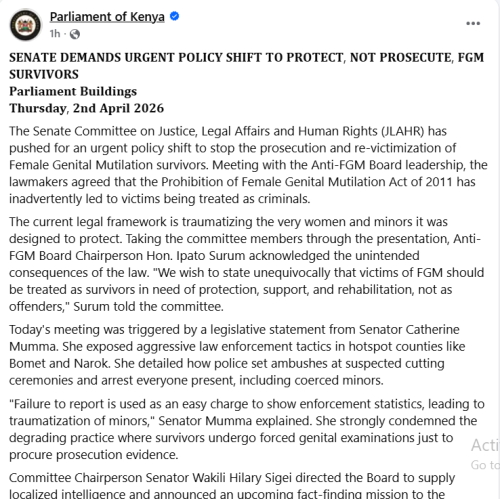
Mumma also condemned the use of forced genital examinations on survivors to obtain evidence for prosecution.
Anti-FGM Board Chairperson Ipato Surum acknowledged the unintended effects of the law. “We wish to state unequivocally that victims of FGM should be treated as survivors in need of protection, support, and rehabilitation, not as offenders,” she told the committee.
Committee Chairperson Senator Hilary Sigei asked the board to submit detailed documentation, including localised intelligence and raw datasets, to support the information presented to the committee.
“The committee requires raw dataset verification and denominators to validate presented prevalence figures and to shape legal and operational responses,” Sigei said, announcing plans for a fact-finding mission to affected counties.
Debate over approach
The discussion highlighted differing views among lawmakers on how to address the practice. Senator Okiya Omtatah criticised what he described as a reactive enforcement model, saying the government should focus on addressing underlying social and economic conditions that sustain FGM.
Senator Veronica Maina pointed to community-based initiatives, including church-led alternative rites of passage, as examples of approaches that help guide young people into adulthood without bodily harm. She urged the government to consider supporting such programmes.
Senator Daniel Maanzo cautioned that strict enforcement alone may push the practice underground, with some cases now carried out secretly or involving medical personnel.
Questions over data
Lawmakers also questioned the accuracy of some statistics presented during the meeting. While the Anti-FGM Board reported that national prevalence had dropped to 14.8 percent, senators sought further clarification on prosecution figures.
Senator Crystal Asige asked for details on sample sizes and denominators used in compiling the data.
In response, the board said it would work with the Kenya National Bureau of Statistics to provide age-disaggregated data and additional information requested by the committee.
The agency also indicated it would support the Senate in reviewing the legal framework to strengthen a victim-centred approach in addressing FGM.