Seeking employment in govt institutions attracts highest bribe – EACC
By Aloys Michael, April 9, 2026For thousands of young Kenyans chasing the dream of a stable government job, the journey often begins not with an interview, but with a quiet, costly demand for a bribe.
A new national survey dubbed the Kenya Gender & Corruption Survey 2025 by the Ethics and Anti-Corruption Commission (EACC) shows a labour market where opportunity is frequently auctioned to the highest bidder.
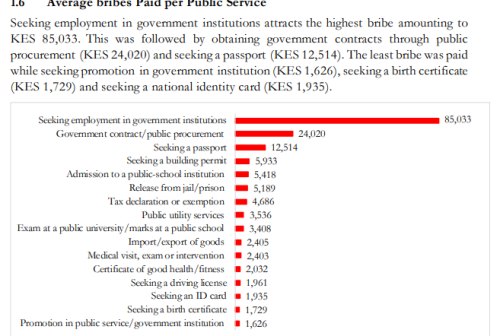
The report indicates that seeking employment in government institutions attracts the highest bribe, averaging Ksh85,033, far above other public services.
This finding lands heavily in a country where unemployment remains one of the most pressing problems, cited by 36.5 per cent of respondents in the same survey.
EACC reveals that corruption has quietly woven itself into the job search process, turning desperation into profit for corrupt officials. After employment, the next most expensive bribes were linked to government contracts (Ksh24,020) and passports (Ksh12,514).
In simple terms, the door to public service, once seen as a ladder to stability, is increasingly guarded by gatekeepers demanding payment.
A price tag on opportunity
The survey warns that this trend threatens fairness and trust in public institutions. It recommends urgent reforms to recruitment systems, noting the need to implement fully transparent, merit-based recruitment systems with independent oversight to address the problem.
Behind the statistics are real stories of frustration; the survey released on Thursday, April 9, 2026, says delays and quiet negotiations in corridors of power.
Participants in focus group discussions described how slow processes are sometimes used to pressure citizens into paying.
“The problem is not only about whether you will eventually get the service but also about how long it takes, especially if you are not willing to pay something extra. Sometimes it even feels deliberate on the part of those working in these offices,” one respondent said.
For young graduates, many already battling unemployment and the rising cost of living, such demands can be devastating. Some borrow money. Others give up entirely.
Corruption becoming costlier
The survey also shows that bribery is not only widespread but becoming more expensive.
The average bribe paid to public officials has risen sharply to Ksh6,724 in 2025, up from Ksh4,878 in 2024.
Most of these payments happen before services are delivered, suggesting that bribery has become a routine entry requirement rather than a reward.
Indeed, the study found that over 84 per cent of bribes are paid before a service is provided, highlighting how corruption is embedded in everyday transactions.
Despite the widespread nature of bribery, many victims remain silent.
The report shows that the biggest reason citizens do not report corruption is a sense of hopelessness.
About one-third of respondents said reporting bribery was useless because nobody would care, while others said bribery had become a common practice.
This silence allows corruption to thrive, turning what should be public service into private business.
The findings come at a critical moment for Kenya, where public sector jobs remain highly sought after for their security and benefits.
EACC says that if corruption continues to dominate recruitment, the talent and merit will be pushed aside, weakening institutions and deepening inequality.
The report makes it clear that the fight against corruption must begin at the hiring desk, where dreams of employment are often tested first.
Because for many young Kenyans, the biggest barrier to a government job is no longer qualifications. It is the price of entry.