Salasya slams Finance Bill 2026 over proposed Mitumba tax
By Ndiritu Wanjiru, May 8, 2026Mumias East Member of Parliament Peter Salasya has decried the proposed Finance Bill 2026, saying that new taxes on second-hand clothes, better known as ‘mitumba’, will affect the small traders, raise consumer costs, and add to the pressure on the country’s informal economy.
Taking it to his X account on Friday, May 8, 2026, Salasya pointed out that several proposals in the Finance Bill may make it more expensive to run a business and lead to “double taxation” and complex compliance arrangements for traders already facing a challenging economic climate.
“A tax on mitumba (second-hand clothing) is a direct hit on the informal sector and mitumba traders. Taxable profit is deemed to be 5% of the customs value of imported worn clothing and footwear.
“The tax is due upon importation and before goods are released by customs. This is a final tax, meaning traders cannot claim expenses or deductions. This will force traders to pay income tax on deemed profit before even selling the goods. Salasya errs on the finance bill 2026 over the mitumba tax,” Salasya argued.
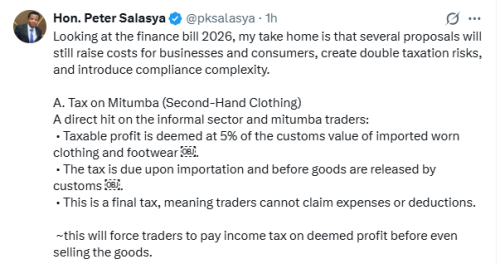
Salasya has said that one of the most controversial measures is to impose a presumptive tax on secondhand clothing and shoes (also referred to as mitumba). The measure would define taxable profit as 5 per cent of the customs value of the imported goods and require that the tax be paid at any time before the goods are released by customs.
Salasya: The new tax is unfair
The first-time lawmaker in the 13th Parliament has noted that the proposed tax would also be final so that traders wouldn’t be able to claim expenses, losses or deductions after the import. This may constitute unfair taxation, particularly for businesses with slim profit margins or losses, critics have said.

He further stated that the Finance Bill 2026 proposals suggest that the government plans to rationalise the tax collection and will decrease what it refers to as a ‘choppy’ enforcement system throughout the mitumba chain. The framework aims to ease compliance and plug revenue loss in the sector, Treasury officials said.