Ruto assents to County Allocation of Revenue Bill 2026
By Kenneth Mwenda, June 29, 2026President William Ruto has assented to the County Allocation of Revenue Bill, 2026, officially unlocking Ksh428 billion for Kenya’s 47 counties for the 2026/2027 financial year.
The signing took place on Monday, June 29, 2026, at State House, Nairobi, after the Senate formally presented the Bill for assent. The law completes the final stage of the county revenue-sharing process and allows the National Treasury to begin preparations for disbursement.
The Bill determines how the county share, already set under the Division of Revenue Act, is distributed among counties through what lawmakers describe as “horizontal allocation” – a formula-based sharing of funds across the 47 devolved units.
During the ceremony, the Clerk of the Senate explained how the Bill moved through Parliament without delay or disagreement.
“This is a bill that was introduced in the Senate by the Senator for Mandera County, Chairman of the Budget, Finance and Budget Committee of the Senate, Ibrahim Ali Roba,” he said. He noted that the Bill was passed with an amendment in the Senate and again passed without amendment in the National Assembly.
He added that the process followed Article 110(5) of the Constitution, which allows a bill to proceed for assent once both houses pass it in the same form without mediation.
“Having been passed in the same form by both Houses without regard to mediation, it is submitted for Your Excellency’s assent by the Speaker of the House in which the bill originated, this being the Senate,” he said.
The clerk outlined the main purpose of the legislation, saying it sets out how counties share the national allocation and how the money is to be managed.
“The principal object of the Bill is the horizontal equitable share due to the county level of government among the counties pursuant to Article 218,” he said. “The Bill sets out in a schedule the respective share of each county and requires the Cabinet Secretary for the Treasury to publish payment schedules for transfers from the Consolidated Fund upon enactment.”
He further explained that the law also introduces budget ceilings for county recurrent expenditure. This, he said, is meant to balance spending between day-to-day operations and development needs.
“This is intended to ensure that there is a fair balance between current expenses and development expenses,” he said.
Parliament also stressed the importance of timing, noting that countries depend on the law to finalise their budgets before the new financial year begins.
“The enactment of this bill is critical for county governments because they cannot conclude their budget processes until they know their share from the equitable allocation,” the clerk said. “It is fitting that it has been passed before the start of the financial year.”
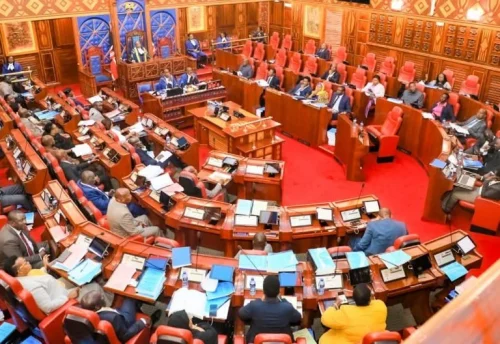
Early passage boosts counties
He added that the June 29 passage marked one of the earliest completions of the process in recent years, helping counties avoid delays that have affected budget implementation in the past.
The law now formalises the distribution of Ksh428 billion to counties. According to Parliament, Ksh387.43 billion will go through a baseline allocation that supports both operations and development programmes across the 47 counties.
A further Ksh4.46 billion will be directed to 12 historically marginalised counties under an affirmative action allocation. Another Ksh36.1 billion will be shared using a weighted formula based on population, poverty levels, income distance and geographical size.
Officials said the framework ensures fairness while responding to inequalities in development across regions.
The Bill follows the earlier passage of the Division of Revenue Act, 2026, which set the overall national revenue split between the national government and county governments. Under that framework, counties receive Ksh428 billion from a total national revenue base of Ksh2.46 trillion, alongside allocations for the Equalisation Fund.
The county allocation represents an increase of Ksh13 billion compared to the previous financial year, which Parliament says will strengthen service delivery in devolved sectors such as health, agriculture, water services, roads and early childhood education.
Officials present during the assent ceremony included Prime Cabinet Secretary Musalia Mudavadi, Senate Speaker Amason Kingi, the Solicitor General, and Treasury Principal Secretary Kiptoo, among others.