Ruto appoints Kindiki to lead Ksh2.2T Lamu oil refinery project
By Faith Lagat, July 8, 2026President William Ruto has appointed Deputy President Kithure Kindiki to chair a government committee that will work with private sector investors on the proposed Ksh2.2 trillion oil refinery project in Lamu.
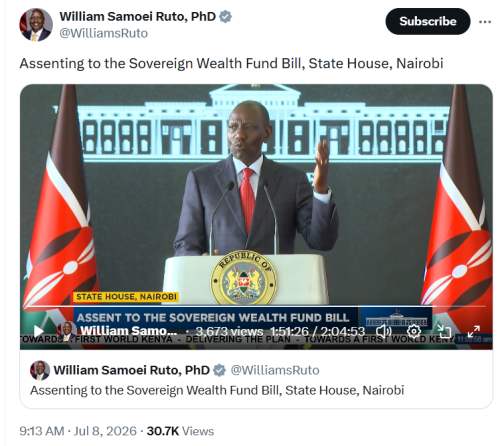
The president made the announcement on Tuesday, July 8, 2026, during the signing of the Sovereign Wealth Fund Bill at State House, Nairobi, saying the refinery will rank among the country’s biggest investments.
“We are moving,” Ruto said. “I have asked the Deputy President to chair the government committee that is going to work with private sector investors… for what will be one of the largest investments in our country, a 2.2 trillion shilling investment.”
He added that a groundbreaking date for the project has already been set.
Lamu refinery committee
Kindiki will oversee government coordination with investors as Kenya advances plans to establish the refinery at Lamu Port, a project expected to strengthen the country’s energy and logistics sectors.
The announcement comes amid renewed investor interest in the port, including plans by Dangote Group to establish a refinery in Lamu.
On Monday, July 6, 2026, Trade Cabinet Secretary Lee Kinyanjui said the planned investment reflects growing confidence in Lamu as a regional transhipment hub.
His remarks followed a meeting with the Horn of Africa Initiative technical team, where officials discussed infrastructure development, trade facilitation and cross-border cooperation involving Ethiopia, Somalia, Sudan, Djibouti and Eritrea.
The refinery project is expected to utilise the operational Lamu Port and the LAPSSET Corridor to provide an export route for crude oil from the South Lokichar Basin in Turkana.
Commercial oil production is expected to begin before the end of 2026 through an 890-kilometre pipeline linking the oil fields to Lamu.
Sovereign Wealth Fund signed into law
The announcement coincided with President Ruto’s assent to the Sovereign Wealth Fund Bill, establishing the Kenya Sovereign Wealth Fund to manage revenues from natural resources and strategic state investments.
The fund will begin with an estimated Ksh200 billion generated from petroleum revenues, mining royalties, proceeds from divestment of state enterprises and other approved sources.
It consists of three components: a Stabilisation Fund to cushion the economy during shocks, a Strategic Infrastructure Investment Fund to finance major projects, and the Future Generations (Urithi) Fund, which will receive at least 10 per cent of inflows.
Chief of Staff Felix Koskei described the legislation as a major milestone in Kenya’s economic transformation agenda.
Under the law, the funds will be held at the Central Bank of Kenya and invested only in approved instruments. The legislation also bars the use of the fund as collateral for government borrowing.
Economic outlook
The government says foreign direct investment has increased from Ksh194 billion three years ago to about Ksh414 billion, reflecting increased investor confidence as Kenya pursues major infrastructure projects.
Former Roots Party deputy presidential candidate Justina Wamae has questioned the timing of the fund’s establishment, citing public debt and food security concerns.
President Ruto, however, said the new legal framework is intended to ensure the country’s natural resource wealth benefits both current and future generations.
“May history record that we honour the trust placed in our generation not by exhausting our nation’s resources but by preserving, growing, and expanding them.”