Ruku: Govt ready to tackle calamities in high-risk areas
By Nancy Marende, August 14, 2025The government has pledged to safeguard livelihoods and avert the devastating impact of recurring disasters that have previously caused the loss of millions of livestock.
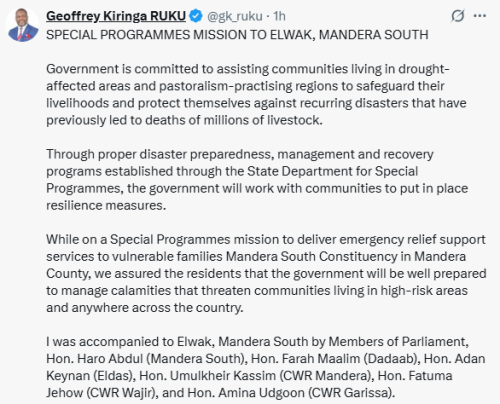
In a statement on August 14, 2025, Public Service Cabinet Secretary Geoffrey Ruku said proper disaster preparedness, management, and recovery programmes, spearheaded through the State Department for Special Programmes, will be central to building resilience in vulnerable areas.
Furthermore, Ruku assured residents that the state is enhancing its capacity to respond to calamities in high-risk areas and across the country.
“While on a Special Programmes mission to deliver emergency relief support services to vulnerable families in Mandera South Constituency in Mandera County, we assured the residents that the government will be well prepared to manage calamities that threaten communities living in high-risk areas and anywhere across the country,” read the statement.
Commtment against drought
This comes months after the government affirmed its commitment to ending drought emergencies in the country as it transitions into the Second Phase of the Common Programme Framework for Ending Drought Emergencies (EDE CPF II).
Speaking in April 2025, Cabinet Secretary for the East African Community, the ASALs and Regional Development, Beatrice Askul, said the framework provides a common strategy around which all stakeholders can harmonise their interventions in support of sustainable livelihoods in Arid and Semi-arid Lands (ASALs).
Further, he said the persistence of drought in the country, including the national emergency declared in the year 2021 reminds us that we still have much more to do to ensure sustainable livelihood.
According to Askul, the Arid and Semi-Arid Lands (ASALs) make up more than 80 per cent of our national landmass, and yet, ASALs remain at the epicenter of climate crises like droughts.
“These regions are rich in potential endowed with natural resources, cultural diversity, and strategic economic importance,” she said, adding that the government is on track in unlocking the region’s potential.
Further, she reported that Kenya experiences an increase in frequent, severe, and prolonged droughts, affecting 1.5 to 4.9 million Kenyans annually.
“The 2021-2023 drought cost over Ksh71 billion in response, resulting in losses of Ksh1.5 trillion between 2008 and 2011. Thus, the Ending Drought Emergencies (EDE) initiative is a multi-stakeholder platform focusing on long-term resilience, coordination, and sustainable development to prevent future droughts from escalating into national emergencies.”