Robert Alai calls for formalisation of informal sector to expand tax base and growth
By Sharon Atieno, June 12, 2026Kileleshwa Member of County Assembly (MCA) Robert Alai has called for urgent reforms to formalise Kenya’s informal sector, saying the country’s economic structure remains imbalanced and is slowing inclusive growth.
In a statement shared on his X account on Friday, June 11, 2026, Alai said millions of Kenyans remain outside the formal tax system despite the heavy tax burden carried by a small segment of the population.
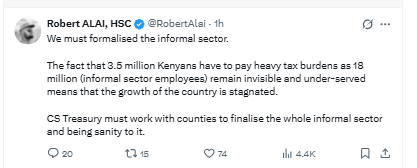
“We must formalised the informal sector,” he said, adding that the current structure, where “3.5 million Kenyans have to pay heavy tax burdens as 18 million (informal sector employees) remain invisible and under-served means that the growth of the country is stagnated.”
/X
He further urged closer coordination between the National Treasury and county governments to streamline the sector and improve revenue mobilisation.
“CS Treasury must work with counties to finalise the whole informal sector and bring sanity to it,” he added.
Ksh502 billion county allocation
His remarks come as Treasury Cabinet Secretary John Mbadi announced that county governments will receive a total of Ksh502 billion in the 2026/27 financial year, aimed at strengthening devolved governance and service delivery.
“Total allocation to county governments is projected at Ksh502 billion, of which Ksh428 billion is the equitable share and Ksh74 billion is traditional allocation from the national government’s share of revenue, loans, and grants from development partners,” Mbadi said while presenting the budget in Parliament.
The Treasury said the allocation is part of efforts to support county operations while maintaining fiscal balance amid rising expenditure pressures.
Fiscal deficit and borrowing outlook
Mbadi also revealed that the 2026/27 fiscal deficit is projected at Ksh1.1462 trillion, equivalent to 5.5 per cent of GDP.
“The 2026 fiscal deficit, including grants, is projected at Ksh1.1462 trillion, equivalent to 5.5 per cent of GDP,” he said.
The deficit will be financed through a mix of external and domestic borrowing, with domestic borrowing expected to take the largest share due to constrained external financing options.
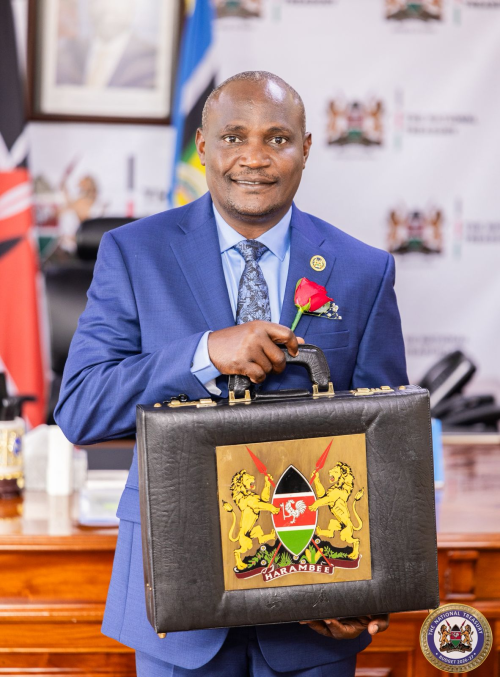
“The fiscal deficit will be financed by net external borrowing of 116.2 billion, equivalent to 0.6 per cent of GDP, and net domestic borrowing of 1 trillion 30 billion, which is equivalent to 4.9 per cent of GDP,” Mbadi stated.
The Treasury maintains that the financing strategy is aimed at balancing development priorities with fiscal stability amid growing debt pressures.