Revealed: 0.1% of Kenyans own more wealth than 99.9% as majority linger in poverty
By Aloys Michael, May 10, 2026A new report on Kenya’s political and economic trajectory has delivered one of the starkest portraits yet of inequality in the country: less than 0.1 per cent of Kenyans own more wealth than the remaining 99.9 per cent combined.
The Bertelsmann Transformation Index (BTI) 2026 Country Report lands at a politically explosive moment, less than two years after nationwide Gen Z-led protests shook President William Ruto’s government and exposed deep public anger over taxes, unemployment, and the rising cost of living.
While Kenya has long marketed itself as East Africa’s economic success story, the report argues that growth has largely failed to translate into broad-based prosperity.
“Despite two decades of average economic growth near 5%, improvements in living standards and social welfare have been visible but comparatively modest,” the report states.
The report shows a country where wealth concentration, debt burdens, and aggressive taxation have collided to create dangerous social pressure.
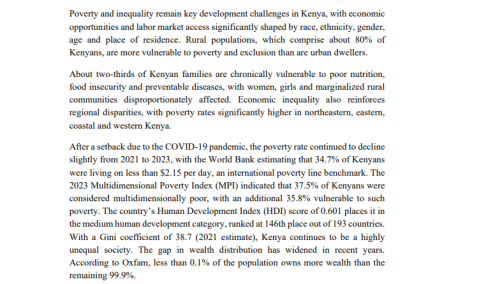
“Poverty and inequality remain key development challenges in Kenya,” the report says, adding that economic opportunities are heavily shaped by race, ethnicity, gender, age, and place of residence.
Economic frustrations exploded in 2024 after the government introduced the controversial Finance Bill, aimed at raising Ksh46 billion through new taxes and VAT increases.
“The proposed measures would have disproportionately affected low-income Kenyans, sparking mass protests led by youth,” the BTI report reads.
Debt burden
The protests culminated in the unprecedented storming of Parliament on June 25, 2024, forcing lawmakers to flee as sections of the building burned. President Ruto later dissolved his Cabinet in an attempt to calm public outrage.
Behind the protests lies a deeper structural crisis.
Kenya’s public debt surged from 39 per cent of GDP in 2010 to more than 73 per cent in 2023, driven largely by heavy borrowing for infrastructure projects.
To stabilise the economy and secure International Monetary Fund (IMF) support, the government pursued austerity measures and higher taxes even as ordinary citizens struggled with inflation, unemployment and shrinking take-home pay.

The report notes that rising deductions through the Social Health Insurance Fund (SHIF) and National Social Security Fund (NSSF) have further intensified frustration among salaried workers.
Meanwhile, the benefits of economic growth remain unevenly distributed. Rural populations and residents of northeastern, coastal and western Kenya continue to face significantly higher poverty rates. Women and young people remain disproportionately excluded from economic opportunity.
The report also warns that democratic trust itself may be eroding under the weight of inequality. It links economic grievances to political instability, civic unrest and declining confidence in institutions.
Even as Kenya’s macroeconomic indicators improve, inflation falling and the shilling stabilising, the report suggests the deeper crisis is no longer simply economic. It is increasingly about legitimacy.