Advertisement
Researcher reaps big from tissue culture seedlings
Tuesday 27th June, 2023 04:00 AM|
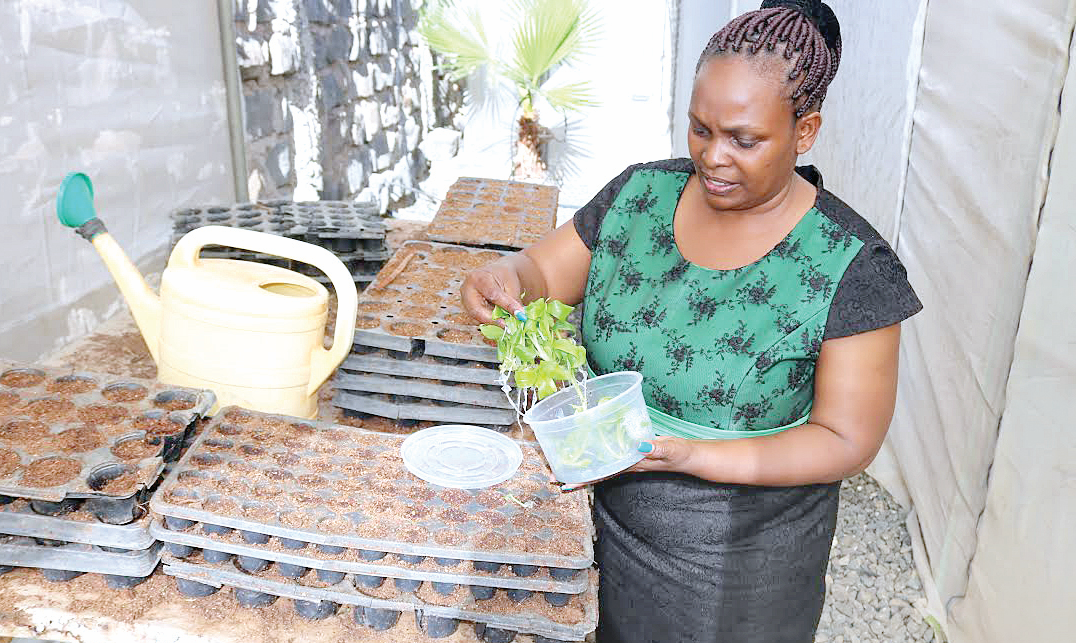
While different people have varied opinions on what agricultural biotechnology can do for our country, Ann Kitisya’s journey in this field is a success story. A story that lays bare how technology can be a massive earner worth investing in.
Ann is the founder of Mimea International Limited (MIL), a private tissue culture agribusiness firm. She has about three decades of experience in agricultural biotechnology and was one of the first Kenyans to set up a privately owned tissue culture lab. She set it up in 2005 after working in different labs for more than 10 years.
“I found myself in the agriculture value chain by default. I am a laboratory technician by profession. I landed in a tissue culture lab during my internship at the University of Nairobi. Though my work as a lab technician was to assist the students and in research work, one day, my supervisor got an emergency he needed to attend to and he asked me to subculture some materials he was supposed to work on,” reembers Ann.
Subculturing is the removal of the medium and transfer of cells from a previous culture into fresh growth medium, a procedure that enables the further propagation of the cell line or cell strain.
Since she had never done it before, she messed up big time. Luckily, the lecturer did not get angry at her, but decided to teach her how to do it. That is what spurred her interest in tissue culture technology. Little did she know that the technology will one day transform her life and that of millions of Kenyan farmers.
After working there for two years and perfecting the art, she secured employment in another tissue culture lab that was propagating pyrethrum and sugarcane. There, she rose through the ranks, starting as a lab technician and ending up as a production manager.
“While working there, I realised that demand for technologically improved seedlings was growing yet very few people had ventured into that area. To close the gap, I decided to start my own tissue culture laboratory as a side hustle in 2004,” she shares.
Commercially apply biotechnology
Since she didn’t have enough money to buy high-tech equipment, she started by fabricating the most important equipment — the air cleanser, also known as the control chamber. To prepare the growth medium, she was using a domestic pressure cooker. Her sister’s house also became her working space.
One year later, the business had started to show good progress and she decided to quit employment and concentrate fully on the business. That is how Mimea International Limited was born in 2005. It was the first private company to commercially apply biotechnology, through tissue culture to produce tissue culture bananas and eucalyptus trees. Previous ventures had been dominated by universities and the Kenya Agricultural and Livestock Research Organisation (Karlo).
“Tissue culture is the regeneration of plants in the laboratory from disease-free plant parts. This technique allows for the rapid multiplication of disease-free planting material for crops. Examples of crops they have produced using tissue culture are strawberries, pineapples, cassava, bananas, sweet potatoes, and pawpaws,” she explains.
She brought onboard another partner to help her build on her financial muscle and together they bought the required high-tech equipment, such as a laminar flow hood, hired more technicians and they were ready to conquer the world.
What started as a small laboratory has now grown to become one of the biggest private companies in Kenya. Currently, they have created employment for about 100 people directly and indirectly and eight permanent staff. The company is now raking a fortune and by extension feeding millions of Kenyans and their families. “It has not been all rosy though. When we started, plant tissue culture was a contentious issue in Kenya and most people were opposed to this technology, we lost about 20 per cent of our first production of about 10, 000 banana plantlets. Also, most farmers were not willing to invest in this technology as our seedlings were a bit expensive when compared with the conventional ones.”
To win public trust and build acceptance, they started demo farms, which catapulted the project to success.
Today, the company produces about 100,000 plantlets of tissue culture bananas and eucalyptus per year. They also do seed multiplication for other crops on order. They have a production capacity of 400,000 plantlets per year.
Ann says even though agricultural biotechnology has the potential to advance crop productivity and improve food security at the global level, not all farmers have embraced it because science has been shrouded in controversies.
Not Genetically modified
Misconceptions, especially about GMOs, are creating major hurdles in the commercialisation of crops that can address unique challenges facing the country. This ideological war continues to deny farmers the right to choose, hampers business opportunities, and creates an opportunity cost for millions of Kenyans.
“What I would like to tell Kenyans is that agricultural biotechnology is not all about Genetically Modified Organisms (GMOs). Genetic modification is just one of the so many technologies that fall under agricultural biotechnologies. We have other technologies, such as tissue culture and plant grafting among others,” she explains.
Ann says it is because of biotechnology they are now able to produce disease-free planting materials, which are high yielding and mature faster. Their plantlets go for between Sh100 and Sh150. They sell them either at the semi-hardened stage or at the hardened stage
Author
Milliam.Murigi
View all posts by Milliam.MurigiLatest News








Advertisement
More on News
