Advertisement
Real estate players hopeful about sector growth this year
Friday 07th January, 2022 04:00 AM|
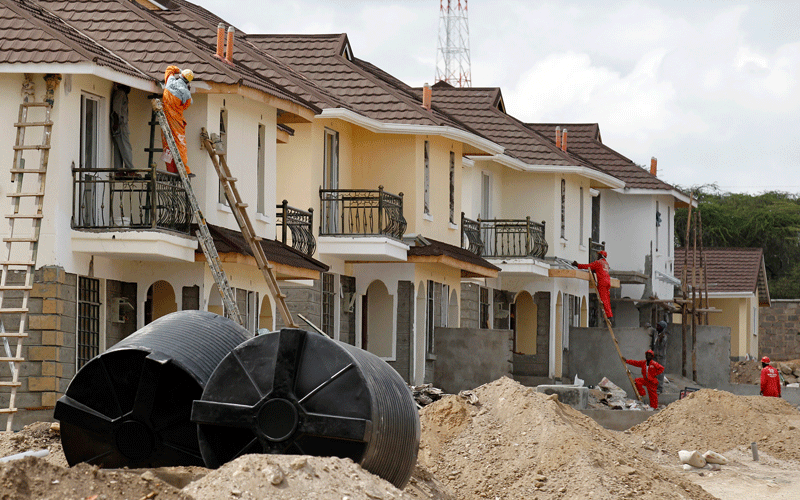
While the industry underwent turbulent times in 2021 occasioned by Covid-19 that caused unprecedented disruption of the economy, realtors are optimistic that Kenyans will double their land purchasing and construction power in 2022.
The unforgiving economic challenges Kenyans grappled with in 2021 will not slow their zeal to purchase land and put up better houses in 2022, real estate players reveal.
In a country where a majority of its population living in urban centres live in rental houses, the pandemic has been blamed for slowing down the government’s bid to bridge the housing gap.
Kenya has an annual housing demand of 250,000 units with an estimated supply of 50,000 units, culminating in a housing deficit of two million units.
Reduced funding to the sector due to general risk aversion during the pandemic has been cited as having contributed to low construction and land purchasing activities.
Many sector players are reported to have closed shop as a result of low business and huge operational costs leaving hardcore firms to survive with few buyers with consequent low profits.
Expected healthy growth
However, the players say despite the challenges the pandemic ignited a home-buying frenzy as the decade-long housing shortage converged with shifting workplace dynamics and new opportunities for young buyers to pursue their first homes.
Peter Kamau, the CEO Dhahabu Land Limited, while regretting that the pandemic resulted in drastic reduction of the labour force and interruption of supply chains causing longer periods in development of projects, he says realtors expect a whirlwind 2022 for the housing market.
He hails Kenyans for learning to survive the hard way and will not delay their investment plans this year, a sign that the sector might experience a healthy growth.
Buying as a better option
He said that with businesses operating normally across the country, the economy will spring back thereby allowing for wider circulation of money and to that effect trigger increased purchasing power.
“The pandemic, like HIV and Aids, is with us and will not be leaving soon. We expect business growth this year to rise and this can only mean people will have money to go for other life goals besides meeting their basic needs,” he said.
A report by Knight Frank in December 2020 indicated that as Kenyans look to cut down on their expenses, many were opting to buy houses instead of renting houses.
This is because buying is cheaper in the long term as compared to paying rent each month.
Additionally, renting a house comes with many uncertainties such as the increase in rent, which is determined by the landlords.
“The pandemic gave buyers time to reflect on how they live and use their space, influencing their future buying plans,” the report read.
Kamau encouraged his fellow investors to broaden their business scope for extra incomes adding that with the steady state of politics, Kenyans will not fear investing in any part of the country as politicians have assured prevalence of peace post the electioneering period.
“Politics will come and go, but Kenya will remain as one. Kenyans need to know that they have no other country to run to and that they must stand to protect the sovereignty of their motherland.
In this case, we expect Kenyans to continue investing without fear of what will happen after the elections,” he urged.
To help the country achieve its housing deficit, Kamau revealed that Dhahabu Land Limited will commence construction of houses for customers who have bought land with them.
He maintained that for the government to achieve the affordable housing agenda, a concerted efforts approach alongside public-private-partnership must be embraced to fasten the housing process.
“In 2023 however, we will open the forum to all Kenyans, even those who have no land with us.
We want to join the government in achieving its dream of according every Kenyan a decent, affordable housing,” he said.
Peter Karoki, the CEO Lifestyle Heights, a property firm with in excess of Sh3.5 billion worth of apartments on its 30-acre apartment complex within Tatu City, a mixed-use real estate project in Kiambu, however, says that while Kenyans will continue to invest, achievement of affordable housing is not tenable before this year when President Uhuru Kenyatta will be exiting office after the end of his two terms.
Delayed housing agenda
Karoki maintained that although the government has been doing everything possible to aid the real estate sector from further collapse, the pandemic already slowed the pace requiring extension of the timelines that had been set earlier. “We will achieve the affordable housing agenda, but not before August. The dream might delay and the likelihood is that the plan will only be actualised by the next government should it be given priority,” he said.
Sharing the same sentiments, Timiza Land Limited CEO Kelvin Muthuri pointed out that 2022 will be a stable year economically and more Kenyans might be pushed to wanting to settle away from urban centres.
Muthuri stated that Kenyans have learnt lessons from the pandemic and have begun to venture in alternative income generating activities, such as farming for survival during crises, such as the Covid-19 pandemic.
“After most Kenyans were fired due to the pandemic, most of them rose to look for money elsewhere.
Some started farming, others ventured into online business, among other areas.
This translates to saying that Kenyans will not be delayed to achieve their housing dream by anything this year. They are and will continue to invest,” stated Muthuri.
Despite the optimism from developers, 2022 is poised to also have some unique issues and challenges ranging from unsolved election questions, tight academic calendars that will affect parents’ expenditure among other issues.
Author
Mathew.Ndungu
View all posts by Mathew.NdunguLatest News








Advertisement
More on News