Postmortem reveals cause of death of a whale in Kwale
By Kenneth Mwenda, December 28, 2025A whale found dead at Leopard Beach in Kwale County has been confirmed to have died due to plastic pollution, the Kenya Wildlife Service (KWS) has revealed. The discovery, made weeks ago, highlights the growing threat of human waste on marine life along Kenya’s coastline.
KWS veterinarian Asuka Takita conducted a postmortem on the whale and discovered a plastic container lodged in its intestine.
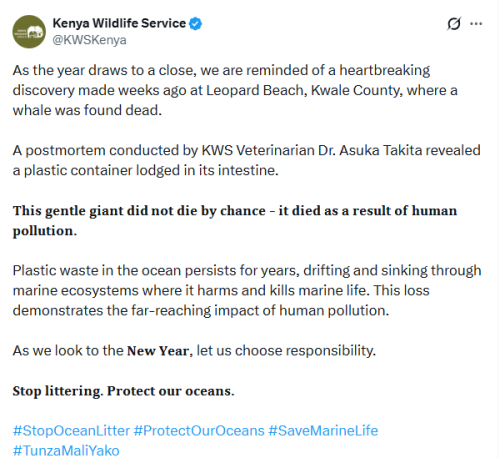
“As the year draws to a close, we are reminded of a heartbreaking discovery made weeks ago at Leopard Beach, Kwale County, where a whale was found dead,” KWS posted on their X account on Sunday, December 28, 2025.
“A postmortem conducted by KWS Veterinarian Dr. Asuka Takita revealed a plastic container lodged in its intestine. This gentle giant did not die by chance – it died as a result of human pollution.”
Communities urged to act
The incident has prompted KWS to urge communities and individuals to take responsibility for their actions.
“Plastic waste in the ocean persists for years, drifting and sinking through marine ecosystems where it harms and kills marine life. This loss demonstrates the far-reaching impact of human pollution,” the agency said, calling for collective efforts to reduce the amount of plastic entering the country’s waterways.
“As we look to the New Year, let us choose responsibility. Stop littering. Protect our oceans.”
When ingested, plastic can block digestion, cause starvation, and eventually lead to death, as demonstrated by this whale. The case illustrates the far-reaching and long-term impact of human activity on marine life.
This is not the first time a whale has washed ashore in Kwale County. In September 2018, a 30-tonne, 14-metre-long sperm whale was found dead at Zote Beach. Residents reported that the whale likely died in the ocean two to three days before its carcass came ashore.
Globally, plastic pollution is a major environmental challenge. Millions of tons of plastic enter rivers, lakes, and oceans each year, breaking down into microplastics that infiltrate the food chain, from plankton to humans.
Experts estimate that roughly 2,000 garbage trucks’ worth of plastic is dumped into aquatic ecosystems daily. Such pollution damages habitats, weakens ecosystems’ resilience to climate change, and poses significant economic, social, and health risks.