Advertisement
People who made a difference this year
Monday 16th December, 2019 12:00 AM|
Peter Tabichi
Thirty-six-year-old Peter Tabichi, a teacher at the Keriko Mixed Day Secondary School in Pwani village, Nakuru county, won the Sh100million Varkey Foundation Global Teacher Prize at a star-studded event in Dubai on March 24 this year.
The mathematics and physics teacher left a job at a private school to join Keriko, where 95 per cent of the students are poor and almost a third are orphans.
The institution also faced many challenges including drug abuse, teenage pregnancies, school dropouts, early marriages and suicide.
Tabichi led the poorly-resourced school to emerge victorious after taking on the country’s best schools in national science competitions.
“Every day in Africa we turn a new page and a new chapter… This prize does not recognise me but recognises this great continent’s young people.
I am only here because of what my students have achieved. This prize gives them a chance. It tells the world that they can do anything,” he said after beating nine finalists from around the world to claim the award.
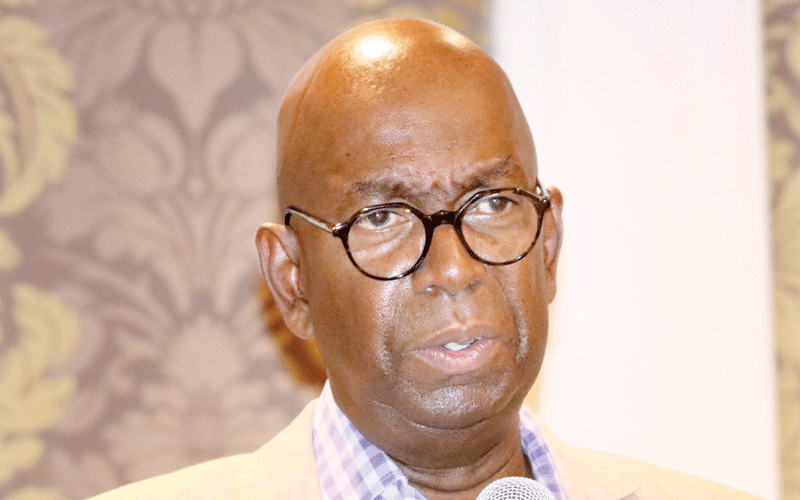
Bob Collymore
Robert William Collymore was the chief executive of East Africa’s largest and most profitable mobile network operator, Safaricom.
He died aged 61 in June, after a two-year battle with cancer. The former CEO was at the helm of the telecom company that has since helped allowed millions of Kenyans excluded from the banking system to transfer money and pay for products via Mpesa.
Collymore left a mark in the lives of many Kenyans, who observed his loss and poured out their tributes in numbers.
Makai Ntalo Mamo, Nasole Women Group
Makai Ntalo Mamo dedicated her life to tame an old age culture that saw women reduced to beggars and denied economic advancement opportunities.
She formed the Nasole Women Group in 2008 and currently, it has 120 members. To join, one needs to pay a registration fee of Sh500.
Her campaign has seen women deliver food at the table, support distant relatives and send more offspring to schools.
The women have taken on responsibilities and are changing the narrative that deemed them second class citizens.
Editar Adhiambo, Feminists for Peace, Rights and Justice Centre
Editar Adhiambo, founder Feminists for Peace, Rights and Justice Centre, has made it her mission to advocate for the rights of women.
Growing up as a disempowered young woman, raped at age six and gang raped at 16, Adhiambo spent most of her life angry at the lack of security for women.
Weeks after she was raped in both incidences, the issue was quickly forgotten and life moved on, just like many other such cases in the community.
In 2017, she founded Feminist for Peace Rights and Justice Centre, an organisation working to create safe spaces for survivors of sexual violence, fight injustices and advocate for women rights in the Kibra slums.
She was also one of the female candidates to vie for the Kibra MP seat upon the death of former MP Ken Okoth.
Jeremiah Kipainoi, Mentors on Tour
After seeing how lack of exposure limited young people from Kajiado from living their best lives, Jeremiah Kipainoi and six of his friends came together to form Mentors on Tour address this problem.
After a series of sessions, they discovered how the young generation lacked role models and exposure to viable careers.
They made it their mission to mentor, train and widen the world views of the youth and children in their community and help handle arising issues such as jigger infestation and school dropouts.
Diana Wambui-Kamau, Sign Language Is Cool
A majority of Kenyans see disability as physical, yet there are invisible ones such as deafness, which makes it hard for the inclusion people with disabilities (PWDs) into everyday life.
It is against this background that Diana Wambui-Kamau vowed to find a way for people with hearing and speaking disabilities to be included in the society.
She founded Sign Language Is Cool (SLIC), to influence able-bodied people by modifying their beliefs, values and attitudes towards the PWDs.
Eliud Kipchoge; 1:59
Olympic gold medalist and world-record holder captured the attention of the whole world in October when he became the first man to run a marathon in under two hours in Vienna, Austria.
Kipchoge made history supported by 36 pacemakers who accompanied him in alternating groups.
This was his second attempt, after missing out by 26 seconds at a similar event on the Formula One track in Monza, Italy, in May 2017.
Florence Otieno, rescuer of widows and orphans
Known for rescuing widows and street children, Florence Otieno is a beacon of hope for many. Fondly referred to as Mama Takataka, she is a mother to hundreds of children she rescued from the streets and is raising at her home in Kisumu.
Most of these children are orphans, left behind by parents who succumbed to the HIV/Aids scourge that swept the village.
Even though she did not have money, she felt she should assist in a small way by bringing some of them to stay with her.
Now at 75, she is proud that the initiative she started over two decades ago has transformed the lives of many in the village and she has achieved global recognition. A good number of her children have since pursued their studies and have gotten jobs.
Sylvia Kasanga, Mental Health Advocate
Nominated senator Sylvia Kasanga, a mental health advocate, sponsored a bill in Parliament early in the year to raise awareness on the status desperation that drives the youth to mental breakdown.
The bill also addressed key issues such as education, outreach and infrastructural support.
She called for the acknowledgment of the different levels and stages of mental health and the need for quality health care centres in a country ranked sixth in number of depression cases at about two million people.
Author
Christopher Owuor
View all posts by Christopher OwuorLatest News



Advertisement
More on News