Pauline Njoroge says national schools must integrate students but not inequality
By Kiprono Keileb, January 7, 2026Pauline Njoroge has weighed in on the national schools placement debate, backing student integration across the country while warning that it should not deepen existing inequalities between regions.
In a statement shared on X on Wednesday, January 7, 2026, Njoroge said allowing top-performing learners to join national schools outside their home areas is a good step for unity, but only if all schools offer similar standards. She argued that national integration loses meaning when students are moved into institutions that are poorly equipped, understaffed, or neglected, calling for equity to go hand in hand with access.
“I have no objection to top-performing students being admitted to national schools anywhere across the country. In fact, this is a positive and necessary step towards national integration and shared nationhood.
But integration must be matched by equity,” the statement reads

Njoroge illustrated her point by comparing students placed in schools across different regions, saying fairness must be felt on the ground, not just spoken about in policy. She noted that a learner crossing regional lines should encounter the same quality of classrooms, laboratories, dormitories, and learning environment, regardless of where the school is located.
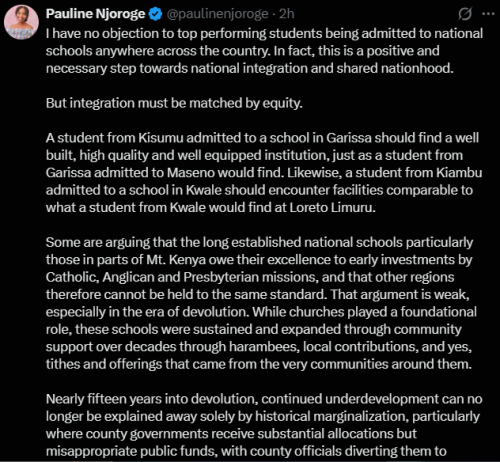
“A student from Kisumu admitted to a school in Garissa should find a well-built, high-quality and well-equipped institution, just as a student from Garissa admitted to Maseno would find. Likewise, a student from Kiambu admitted to a school in Kwale should encounter facilities comparable to what a student from Kwale would find at Loreto Limuru,” the statement reads
She also challenged arguments that excuse disparities by pointing to the historical role of missionary churches in building some of the country’s most established schools. While acknowledging that churches laid the foundation, Njoroge said communities and public support sustained and grew these institutions over decades, a responsibility she believes all regions can still embrace today.

“Some are arguing that the long-established national schools, particularly those in parts of Mt. Kenya, owe their excellence to early investments by Catholic, Anglican and Presbyterian missions, and that other regions therefore cannot be held to the same standard. That argument is weak, especially in the era of devolution. While churches played a foundational role, these schools were sustained and expanded through community support over decades through harambees, local contributions, and yes, tithes and offerings that came from the very communities around them,” the statement reads
Turning to governance, Njoroge said the promise of devolution can no longer be undermined by poor leadership and misuse of public funds. She pointed out that counties and constituencies receive significant allocations meant to improve local institutions, yet some areas continue to lag due to mismanagement.
“Nearly fifteen years into devolution, continued underdevelopment can no longer be explained away solely by historical marginalisation, particularly where county governments receive substantial allocations but misappropriate public funds, with county officials diverting them to personal investments in Nairobi, instead of empowering local communities. We have also seen constituencies like Kiharu where CDF has been deliberately and effectively invested in building and renovating academic institutions, while in other areas, one is left wondering how local leaders utilise the resources allocated to them,” she stated

She concluded by urging citizens, leaders, and communities to take shared responsibility for building strong schools, arguing that equal opportunity will only be achieved through accountability and deliberate action.
“Devolution was meant to equalise opportunity. Citizens must now demand better governance, accountability and deliberate investment in quality institutions from their leaders all the way from the ward to the national level. Communities, too, have both the right and the responsibility to organise, contribute and build the schools they previously could not afford, now that the resources and authority finally exist,” she stated.
“And perhaps we must also confront a quiet shift in our priorities. Today, we see countless church harambees raising millions, yet far fewer collective efforts towards school development. That imbalance is worth fixing, because the future we pray for must also be one we deliberately build.”