Parliament unveils Finance Bill 2026 targeting six major tax laws
By Mustafa Juma, May 9, 2026The Parliament of Kenya has officially published the Finance Bill 2026, setting the stage for another major national debate on taxation, revenue collection, and government spending.
The Parliament of Kenya, in an update issued via Facebook on Saturday, May 9, 2026, said the bill, which was published on May 5, 2026, was submitted to the National Assembly of Kenya by the Cabinet Secretary for the National Treasury and outlines a series of proposed changes aimed at raising government revenue.
Six major tax laws targeted
According to Parliament, the proposed legislation seeks to amend six key tax-related laws.
The targeted tax laws include the Income Tax Act, the Value Added Tax (VAT) Act, the Excise Duty Act, the Tax Procedures Act, the Miscellaneous Fees and Levies Act, and the Stamp Duty Act.
The proposed amendments are expected to affect tax administration, compliance, and revenue collection across multiple sectors of the economy.
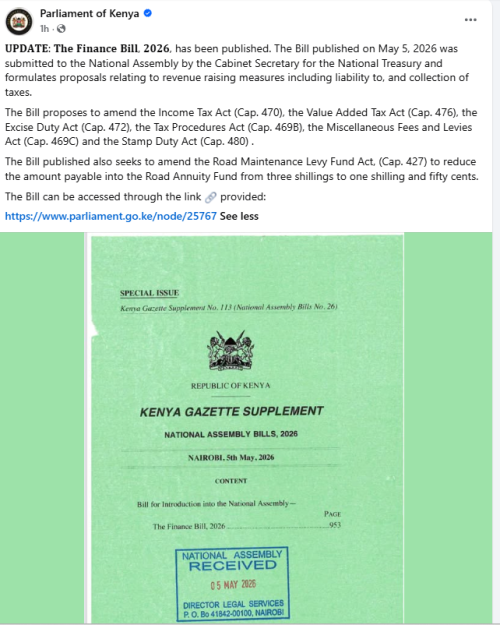
“𝐔𝐏𝐃𝐀𝐓𝐄: 𝐓𝐡𝐞 𝐅𝐢𝐧𝐚𝐧𝐜𝐞 𝐁𝐢𝐥𝐥, 𝟐𝟎𝟐𝟔, has been published. The Bill published on May 5, 2026 was submitted to the National Assembly by the Cabinet Secretary for the National Treasury and formulates proposals relating to revenue raising measures including liability to, and collection of taxes,” the notice reads in part.
“The Bill proposes to amend the Income Tax Act (Cap. 470), the Value Added Tax Act (Cap. 476), the Excise Duty Act (Cap. 472), the Tax Procedures Act (Cap. 469B), the Miscellaneous Fees and Levies Act (Cap. 469C) and the Stamp Duty Act (Cap. 480).”

On the income tax, the Finance Bill 2026 is seeking to shift the annual tax return filing deadline from June to April.
The Finance Bill 2026 seeks to amend Section 52 of the Income Tax Act by replacing the phrase “within a reasonable time, not being less than thirty days from the date of service of the notice” with “by the last day of the fourth month following the end of the person’s year of income.”
The Bill also introduces a new subsection (1A), requiring that a return relating to a nil amount of tax payable be filed within one month after the end of the year of income.
In addition, the proposal replaces the current wording in subsections (i) and (ii) of Section 52(1), which sets filing at “not later than the last day of the sixth month,” with a new deadline of “by the last day of the fourth month following the end of the person’s year of income.”
The Finance Bill 2026 further provides for a nil-return rule, requiring such returns to be submitted within one month after the end of the financial year.
The bill also proposes a 25% excise duty on mobile phones. There is also a new 5 per cent presumptive tax framework on mitumba imports.
On VAT on digital financial services, the Finance Bill seeks to standardise taxation across fintech platforms.
It also seeks to close existing regulatory gaps and ensure tax neutrality in the digital financial sector.
Withholding tax on interchange and merchant fees targets previously under-taxed financial transaction streams and is intended to strengthen tax collection at source through direct deductions.
The deemed dividend tax, which applies to 60 per cent of undistributed income, is intended to curb prolonged tax deferral and ensure that retained earnings are commercially justified rather than used to avoid taxation.
Changes to fuel and road levy allocations
The Finance Bill 2026 also proposes amendments to the Road Maintenance Levy Fund Act.
One of the notable proposals seeks to reduce the amount allocated to the Road Annuity Fund from Ksh3 to Ksh1.50.
“The Bill published also seeks to amend the Road Maintenance Levy Fund Act, (Cap. 427) to reduce the amount payable into the Road Annuity Fund from three shillings to one shilling and fifty cents,” the notice reads.
Treasury pushes new revenue measures
Parliament stated that the bill contains proposals relating to “revenue-raising measures, including liability to, and collection of taxes,” signalling continued government efforts to strengthen domestic revenue mobilisation.
The publication comes at a time when taxation remains a highly sensitive political and economic issue amid rising cost-of-living concerns and public scrutiny over government expenditure.
Other tax measures in Finance Bill 2026
The bill also proposes an increase in residential rental income tax from 7.5 per cent to 10 per cent. This is supported by enforcement reforms, including agent-based withholding systems meant to improve compliance rather than simply raise rates.