Parliament honours late Justice Mohammed Ibrahim in closing-of-file proceedings
By Ndiritu Wanjiru, March 10, 2026The National Assembly Speaker Moses Wetang’ula has praised the great service of the late Supreme Court judge Mohamed Ibrahim, saying he was a jurist whose service to justice and human dignity has left a mark in the judicial system of Kenya.
In a statement released via the official social media of parliament on Monday, March 9, 2026, parliament has noted in an event that was attended at the Supreme Court of Kenya that Wetang’ula termed Justice Ibrahim a protector of the Constitution whose composed temper, upright integrity and scholarliness contributed towards shaping the Kenyan jurisprudence which was changing.
“His total devotion to justice and human dignity made him a towering presence in Kenya’s constitutional journey. Today, as we close his judicial file, let us not see it as an ending but a continuation of the journey he began, a journey of justice, integrity and service,” Wetang’ula said.
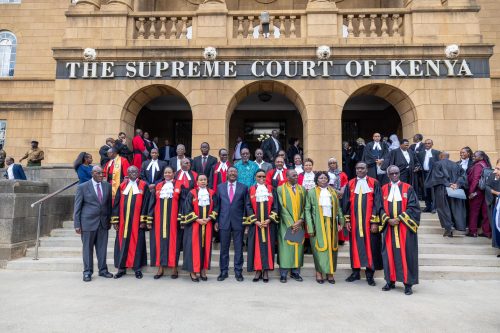
This was a solemn and ceremonial closing of the judicial file of Justice Ibrahim after he died of a prolonged illness, an illustrious era of service at the Supreme Court. Chief Justice Martha Koome, judicial members of the Supreme Court, the legal fraternity and other dignitaries also attended the event to pay tribute to the legacy of the late judge.
Wetang’ula further observed that the late judge contributed a lot to enhancing constitutionalism and making justice affordable to every Kenyan citizen. The Speaker also commended Justice Ibrahim to be an advocate of social justice, to enhance the rights of minority groups and to mentor young lawyers coming into the law practice.
Wetang’ula noted that the judge was convinced that the Constitution was supposed to be a living document that is responsive to the aspirations and real lives of citizens.
Wetang’ula also pointed out the historic milestone of Justice Ibrahim, who was admitted as an advocate of the High Court in 1983 as the first representative of the Somali community in Kenya into the legal profession, as a major achievement in the direction of inclusivity in the legal profession in Kenya.
The speaker, quoting civil rights leader Martin Luther King Jr, reminded leaders that injustice in one place poses a threat to the safety of justice everywhere and challenged the institutions to make the law a fortress of the vulnerable and the marginalised.
Wetang’ula further added that in spite of the fact that the judicial file had been officially closed, the legacy of integrity, fairness and service by Justice Ibrahim would remain to guide generations to come in Kenya’s justice system.
Justice Ibrahim’s career path
The Judiciary of Kenya, led by Chief Justice and President of the Supreme Court Martha Koome, today held Closing of File proceedings in honour of the late Justice Mohammed Khadhar Ibrahim, recognising his distinguished service to the law and the nation.
During the solemn ceremony, Chief Justice Koome described the tradition as a symbolic reminder of the noble responsibility of judges and advocates to uphold the rule of law with integrity, professionalism, and dedication.
Before joining the bench, Justice Ibrahim was a fearless advocate for human rights, democratic governance, and constitutional reform, often standing with the voiceless at great personal risk, including detention without trial.
His work underscored his belief that the law should protect the vulnerable and restrain abuses of power.
Justice Ibrahim was appointed to the High Court of Kenya in 2003, serving across civil, commercial, constitutional, and criminal law divisions.
Notable milestones include serving in the Civil Division (Nairobi) and Commercial Division (Milimani), handling disputes ranging from banking and securities to intellectual property.
He also joined the Judicial Review and Constitutional Division in 2004, shaping constitutional jurisprudence during a transformative period in Kenya.
He served as a resident judge in Eldoret (2007) and Mombasa (2009), presiding over civil, criminal, and landmark cases, including piracy trials and constitutional bail rulings.
In 2011, he was elevated to the Supreme Court of Kenya, joining the inaugural bench under the 2010 Constitution, participating in key presidential election petitions and constitutional interpretation cases.