Parliament calls for strict audit compliance in public universities
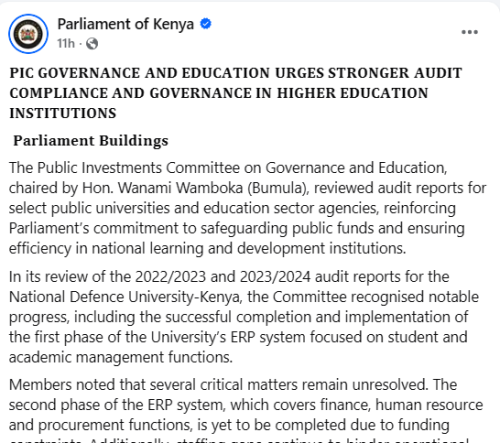
By Kiprono Keileb, November 6, 2025The Public Investments Committee on Governance and Education has urged public universities and education institutions to strengthen governance and strictly comply with audit recommendations to safeguard public funds.
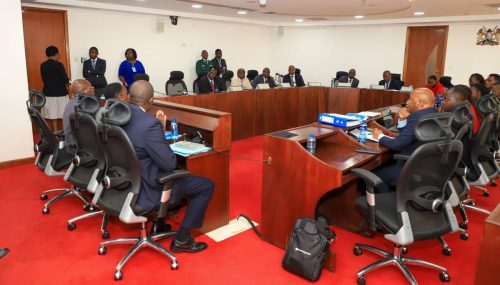
Chaired by Bumula MP Wanami Wamboka on Wednesday, November 6, 2025, the Committee reviewed audit reports for select public universities and sector agencies, emphasising the need for efficiency, transparency, and accountability in Kenya’s higher education system.
During the review of the 2022/2023 and 2023/2024 audit reports for the National Defence University-Kenya, the Committee acknowledged progress, including the successful completion of the first phase of the University’s Enterprise Resource Planning (ERP) system, which manages student and academic functions. However, several challenges remain unresolved.
“The second phase of the ERP system, covering finance, human resources, and procurement functions, is yet to be completed due to funding constraints. Additionally, staffing gaps continue to hinder operational effectiveness, while documentation for the University’s land remains outstanding,” the Committee noted.
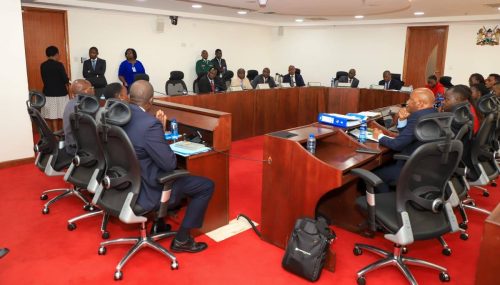
Wamboka welcomed the Ministry of Defence’s commitment to finance the completion of the ERP system in the 2025/2026 financial year and called for continued audit monitoring to ensure full automation, proper asset documentation, and strengthened human resource structures.
“The Committee also expressed concern over delayed appearances from key institutions such as the National Cohesion and Integration Commission (NCIC), the University of Nairobi, and Dedan Kimathi University of Technology. “Scheduled appearances by the National Cohesion and Integration Commission (NCIC), the University of Nairobi and Dedan Kimathi University of Technology, to address outstanding audit observations spanning multiple financial years, could not proceed as key officials were unavailable,” the statement reads
Persistent staffing shortages at the Kenya National Qualifications Authority (KNQA) were also highlighted, with the Committee urging the Authority to expedite recruitment to ensure it is adequately resourced to execute its mandate.
“The Committee also considered the performance of the Kenya National Qualifications Authority (KNQA). The Committee noted persistent staffing shortages at the Authority, with the majority of approved positions yet to be filled,” the statement reads
Site inspection visits are planned at Meru National Polytechnic to address pending audit queries related to irregular contract variations and construction projects. Meanwhile, financial inaccuracies noted at the National Biosafety Authority led the Committee to cite the Finance Officer for incompetence.
“Public institutions must lead by example in compliance, transparency and prudent management of resources in support of Kenya’s human capital development agenda,” Wamboka emphasised in his closing remarks.
The Committee’s findings underscore Parliament’s continued commitment to ensuring that public universities and agencies manage resources responsibly and deliver quality education that benefits all Kenyans.