Parliament approves bill to boost counties with more funds
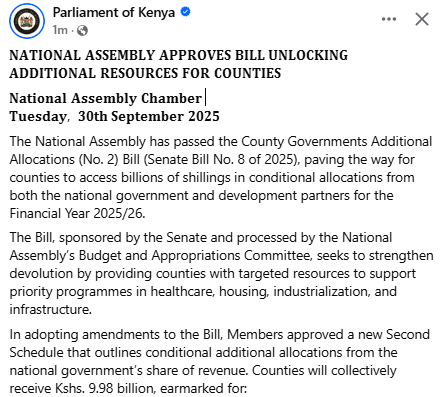
By Kenneth Mwenda, September 30, 2025The National Assembly has approved the County Governments Additional Allocations (No. 2) Bill, clearing the way for counties to receive billions of shillings in conditional funds from the national government and development partners in the 2025/26 financial year, as announced on Tuesday, September 30, 2025.
“The Bill, sponsored by the Senate and processed by the National Assembly’s Budget and Appropriations Committee, seeks to strengthen devolution by providing counties with targeted resources to support priority programmes in healthcare, housing, industrialization, and infrastructure,” the statement on their Facebook account read.
The law allows counties to access Ksh9.98 billion in conditional allocations from the national government, as well as Ksh57.7 billion from development partners.
According to the Budget and Appropriations Committee, chaired by Kiharu MP Ndindi Nyoro, the allocations will address key areas such as doctors’ salary arrears, the Community Health Promoters programme, and the construction of new county headquarters.
In addition, counties such as Kajiado, Kericho, Kitui, Laikipia, Marsabit, Nyeri, and Vihiga will each receive Ksh250 million to develop aggregation and industrial parks. Other counties, including Isiolo, Lamu, Nyandarua, Tana River, and Tharaka Nithi, will benefit from funding to build new county headquarters.
Parliament also adopted a new schedule to provide loans and grants from international partners. These resources will go into major projects such as the Food Systems Resilience Project, the Kenya Urban Support Project, and the Informal Settlements Improvement Project.
Nyoro said the passage of the Bill shows Parliament’s commitment to strengthening devolution. He explained that the additional allocations will give counties the financial space to run key projects and deliver essential services. The Bill will now proceed for assent by the President.
County payments
However, governors have raised concerns that a parallel government initiative is undermining county operations. On Monday, during the 28th Ordinary Session of the Intergovernmental Budget and Economic Council (IBEC) in Nairobi, the Council of Governors (CoG) warned that the rollout of the electronic procurement system (e-GP) has disrupted service delivery.
CoG Chair Ahmed Abdullahi said the transition to the new system was rushed and poorly planned. He noted that counties have struggled to integrate it with existing financial tools, leading to delays in salary payments and the procurement of essential supplies.

Abdullahi explained that some hospitals have gone without medicines, while garbage collection in several towns may stall because fuel suppliers might cut off counties that could not pay on time. He added that mistakes in the Integrated Financial Management Information System (IFMIS), which works alongside e-GP, had left some counties unable to pay workers.
“This quarter has been disastrous,” Abdullahi told the meeting attended by Deputy President Kithure Kindiki. “We have not been able to spend money at all on account of the challenges that we’ve had.”
Governors stressed that while they support automation, the current system has slowed down rather than improved efficiency. They warned that unless the rollout is reviewed, counties will continue to face unnecessary hardships that will affect both service delivery and development.