Advertisement
Parents of Iran school bombing victims describe their worst day
Saturday 28th March, 2026 04:06 PM|
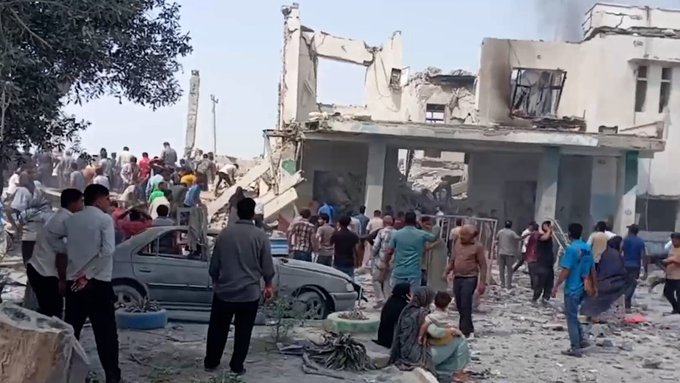
Hours before the world learned that a US missile had hit Shajareh Tayyebeh school, parents were already searching the rubble for their sons and daughters. In this exclusive report, four families describe the events of 28 February
Zahra’s family
When Marzieh heard the first bang, an almighty crash that rattled the room, her first thought went to her youngest son, Mohammad. He must have got out on to the balcony and discovered a new game, she thought: using all of his small might to smash its sliding doors closed.
Marzieh stood up from where she was working at her sewing machine, and shouted for him to stop.
“Mum, it wasn’t me,” he called back.
You Might Also Like



Then, the second crash sounded, the force of it making the entire house tremble. Could it be the neighbours, she wondered – construction work, renovations? But even as the thought occurred, she knew it wasn’t right: their nextdoor neighbours had all left for work that morning, and only she and Mohammad were at home.
Just a few minutes earlier, at 11.17am, Marzieh had received an abrupt phone call from Mrs Mohammadian, her eight-year-old daughter Zahra’s teacher.
The primary school, a few blocks away, was closing early, she said – could the family pick Zahra up? But Mrs Mohammadian hadn’t said why, swiftly concluding the message to call the next parent on her list. Marzieh rang her husband at work, who sent his brother to pick up the girls – Zahra and her cousin were in the same class.
Now, standing in the house, Marzieh felt a strange, numb feeling settle in. She looked down, and noticed she was shaking. From the street outside she could hear voices, and so Marzieh gathered up Mohammad, rushing to find her chador (veil) to leave the house.
As she opened the door, the acrid smell of smoke hit her. People ran back and forth down the road. She stopped someone to ask what was happening. “War has started,” they said.
Sobhan and Hanieh’s family
That morning had dawned clear, gentle, almost completely cloudless, and Mohammadreza Ahmadi had opted to take the school run. His work sometimes took him away from Minab for weeks at a time, so when he was home he liked to make the most of his time with the children: Sobhan, 10, Hanieh, seven, and their younger sister Hannan, still a toddler.
Sobhan was particularly devoted to his father. An affectionate, demonstrative boy with bright wide eyes and a thick thatch of wavy hair, he would follow his father from room to room and loved to leap on Ahmadi’s shoulders, undeterred by scolding that he could hurt Dad’s back.
Both parents doted on Sobhan – their only son, he arrived after a series of miscarriages and a difficult pregnancy for Marzieh Ashena.
Shortly after he was born, they were told that his growth was delayed. As Sobhan grew into a happy but non-verbal toddler, they devoted themselves to helping him thrive.
Every weekday, Ashena – then pregnant with Hanieh – would take her son to a language therapy centre in Bandar Abbas, a three-hour round trip from Minab. At four, he learned to speak.
So it was no small thing to have him attending the local primary school with his sister. Hanieh was playful, the clown of the family: she liked to copy accents and make her parents laugh.
She had taken to imitating her mother as she did the housework: her new favourite game was to empty her entire wardrobe on to the bed and then, imperfectly but with great concentration, fold each item back up.
When Ahmadi dropped them off that morning, Sobhan tumbled out of the car and grabbed Hanieh in a bear hug, making their father chuckle. I am lucky to have a son who cares so much for his sister, he thought. He waited at the kerb, watching until the children disappeared into the school doorway before driving away.
A few hours later, he got a call from Sobhan’s teacher that the children would need to be picked up. Ahmadi got back in the car and headed for the school.
Arya’s family
A little way across town, Marzieh Mansouri, too, had received the call. Her phone lit up at 11.05, with the number of Mrs Zamani, a teacher at her son Arya’s school.
When she saw the contact on the screen, Mansouri, a stay-at-home mum and “generally anxious person”, immediately began to worry. Arya, nine, was a careful, studious boy, with a thick, side-swept fringe, large pair of red-framed glasses and gentle dimples.
He was close to his mother; he would watch her make cakes, carefully writing the ingredients on a Post-it note and sticking it to the fridge so he could try it himself. She wondered if he was sick, or had a cold. “Is he OK?” she asked.
Mrs Zamani reassured her: Arya was fine, but the school was closing after news of an attack on Tehran, and someone would have to come and pick him up. Amazed, Mansouri turned on the television, watching the news of the US-Israeli attack as she tried to contact her brother to bring Arya home. Silently, she began to pray.
Zahra
As thick smoke drifted down her street, Marzieh stepped back into the shade of the garage. With Mohammad playing on the floor next to her, she made call after call. She rang her brother-in-law, who was picking up the girls. She called his wife, to see if they were safe. She rang her husband – he too was making his way to the school. She dialled the brother-in-law again: nothing.
Then, the phone lit up with her brother’s number. He had heard a rumour that a bomb had hit the school, he said. Where was Zahra?
Marzieh called Zahra’s teacher, Mrs Mohammadian. No answer. She called her Qur’an teacher, Mrs Kamali. No answer. She called the school principal. Nothing. Going through her contacts, she called every number she had saved for someone connected to the school over the years that her children had attended – every teacher, every administrator, even the caretaker.
One by one, they rang out. No one answered.
Arya
As she tried to digest the news that war had arrived in Tehran, Mansouri, too, had heard a distant bang, followed by another a few minutes later. Suddenly, her husband called.
He was at work, teaching a culture class in a nearby village. “What’s happening?” she asked him. A plane had flown over, he said, and had hit something in Minab – he wasn’t sure what. Hanging up, she called Mrs Zamani back to check on Arya, but this time there was no answer.
Mansouri was jolted by a bang at the door. Opening it, she found the neighbourhood in turmoil. In the chaos, she heard someone say that a building near the school had been hit.
She started yelling in panic, screaming for someone to check what had happened, to see if the school was OK. At some point, she found herself crouching by the side of the road as neighbours tried to calm her. She called her brother again, who was picking up the children. “Has the school been hit?” she asked him.
“Yes,” he replied.
Mansouri tried to compose herself. Surely, even if it were damaged, she reasoned, the school would not have taken a direct hit. When her relatives arrived she insisted they drive her straight there.
As they got closer, the roads were choked with cars, hundreds of people trying to reach the same destination. A few blocks from the school, three men directing traffic brought them to a halt.
Then, Mansouri spotted a figure out the window: a woman, wearing the uniform of the school’s staff, walking away from the building. She was completely covered, head to toe, with grey dust. Mansouri called out to her: had she seen Arya’s teacher? Had she seen Mrs Zamani?
The woman just looked at her mutely. She did not answer. Then she walked away.
Sobhan and Hanieh
Ahmadi, too, had been halted by the gridlock surrounding the school. After sitting at a standstill, he parked the car and made his way to the school on foot.
But when he walked through the gate, he could not understand what he was seeing. “I was confused and kept searching for my children’s classrooms,” he says. The scene made no sense. “My daughter’s classroom was entirely flattened.”
Zahra
Hossein, Marzieh’s husband, had been the first of them to arrive. Walking through the school gates, he saw a scene of devastation.
The school building was segregated, with a staircase and a door separating the girls’ and boys’ sections. The boys’ section was still partly standing. But the area where the girls took their lessons had been levelled. All he could see was a grey mass of dust and rubble.
Rushing forward, Hossein joined the men at the pile of debris, heaving up chunks of stone, hoping to find a child beneath them – injured, perhaps, but alive. He concentrated his efforts near where he thought the school’s staircase would have been: he had an idea that Zahra “might have tried to escape and got stuck”, he says. The air filled with the shouts of men and wailing of women. Hossein worked methodically. He dug, tossed the stone aside, dug.
Somewhere in the chaos, Marzieh, too, had arrived at the school, after begging a neighbour to drive her. As she looked across the yard to the girls’ section, “all I saw was rubble”, she says. Each time a child was dragged out, she would ask if they were alive. Occasionally, someone would say yes, and the women around her would say: “See, they are alive. Pray!”
Author
Latest News







Advertisement
More on News