Otieno Willis explains why Kenya finds itself in economic turmoil
By Faith Lagat, August 2, 2025Political analyst Willis Evans Otieno has stirred fresh debate over Kenya’s economic crisis, blaming the current fiscal turmoil on years of reckless borrowing under the Jubilee administration, in which President William Ruto served as deputy president.
In a series of posts on August 2, 2025, Otieno argued that while debt can be a legitimate tool for development, the period between 2013 and 2023 reflected what he termed “economic vandalism masquerading as development.” He accused the government of breaching constitutional principles and legal frameworks that guide fiscal responsibility.
“What happened between 2013 and 2023 was economic vandalism,” he said. “Debt is not inherently bad when invested wisely,” he added, calling for public funds to be directed toward productive projects with long-term returns, rather than politically driven infrastructure with questionable impact.
Jubilee-era borrowing
Otieno criticised the Jubilee regime’s borrowing spree, saying it ballooned public debt to over Ksh10 trillion —well beyond the Ksh1.3 trillion limit aligned with fiscal sustainability. He pointed to violations of Article 201 of the Constitution, which outlines transparency, accountability, and equity in public finance, as well as the Public Finance Management Act.
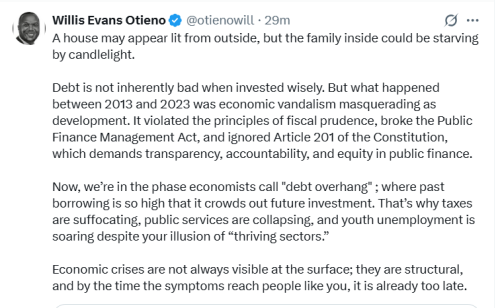
The consequences of this mismanagement, he noted, are now visible in what economists describe as a “debt overhang”—a ”condition where excessive past borrowing hampers future investment. Kenya’s debt-to-GDP ratio stood at 69.6% by June 2024, according to Cytonn Investments, with debt repayments consuming more than half of the country’s revenue.
Public services on the brink
Otieno warned that structural economic problems are being masked by surface-level projects. “A house may appear lit from outside, but the family inside could be starving by candlelight,” he wrote, referencing the illusion of progress while essential services crumble.
The education sector is among the hardest hit. Funding gaps have threatened the free education program, with shortfalls of Ksh 5,344 per secondary school student and Ksh 5,042 per junior secondary student.
Treasury Cabinet Secretary John Mbadi recently admitted to a cash crunch, while Kakamega Senator Boni Khalwale raised concerns about the sustainability of key programs.
Fuel prices have risen to Ksh 186 per litre, with Kenyans bearing the brunt of heightened taxation. Allegations of misappropriated funds—such as Ksh 50 million paid to nonexistent schools—have only deepened public frustration.
Call for fiscal reforms
Otieno’s remarks have amplified calls for sweeping fiscal reforms and a return to constitutional discipline in public finance. “Economic crises are not always visible at the surface,” he cautioned. “They are structural, and by the time the symptoms reach people like you, it is already too late.
His message underscores the urgency of restoring fiscal prudence and ensuring debt is used as a vehicle for inclusive, sustainable development.