Orengo’s message to Kenyans ahead of Saba Saba anniversary
By Mabonga Makhanu, July 6, 2025Siaya County Governor James Orengo has backed the upcoming Saba Saba protests planned by Gen Zs starting Monday, July 7, 2025.
Through a statement on his official X account, Orengo reflected on the original vision of the Saba Saba movement, saying it was rooted in the 2010 Constitution. However, he expressed concern that the values it stood for have been steadily eroded, including the weakening of key institutions and the blurring of lines between church and state.
As one of the original founders of the Saba Saba movement in the early 1990s, Orengo emphasised the need to continue the struggle. He expressed solidarity with the youth and urged them to carry on the legacy of movements like Mwakenya and Saba Saba as they push for accountability and reforms.
His support comes at a time when Gen Zs across the country are mobilising for sustained protests against issues ranging from governance to rising inequality.
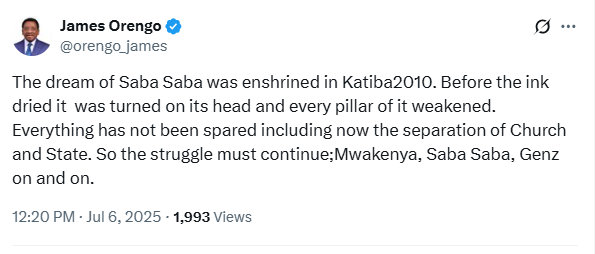
“The dream of Saba Saba was enshrined in Katiba 2010. Before the ink dried, it was turned on its head, and every pillar of it weakened. Everything has not been spared, including the separation of church and state. So the struggle must continue: Mwakenya, Saba Saba, Genz, and on and on,” Orengo said.
Saba Saba protests
On July 7, 1990, Kenya’s Saba Saba protests marked a turning point in the fight for multiparty democracy.
Under Daniel arap Moi’s regime, a 1982 constitutional amendment had entrenched KANU’s one-party rule, stifling dissent. Economic hardship, corruption, and the murder of Foreign Minister Robert Ouko fuelled public anger.

Activists like Kenneth Matiba and Charles Rubia planned a pro-democracy rally at Nairobi’s Kamukunji Grounds, demanding political reform. Despite government bans and the arrests of key organisers, thousands gathered on July 7, sparking nationwide protests. Police responded with tear gas, batons, and live bullets, killing over 20 people and injuring thousands.
The four-day unrest, which spread to Nakuru and Nyeri, highlighted widespread discontent. The Saba Saba protests forced Moi to repeal Section 2A in 1991, restoring multiparty politics. This ‘Second Liberation’ movement laid the groundwork for Kenya’s democratic reforms, though challenges like police brutality persist during annual commemorations.