Advertisement
One year later, Gen Z protesters bear deep scars of a nation’s brutal crackdown
Wednesday 25th June, 2025 04:00 AM|

June 25, 2024, was one of the darkest days in Kenya’s history. The streets were calling, and only the brave had the guts to answer.
Thousands of Gen Zs and a sect of millennials from all parts of the country took to the streets to fight financial oppression, which was about to be imposed on Kenyans by the government.
According to the youth, the Finance Bill of 2024/25 was nothing short of oppressive to the Kenyan citizens who were already grappling with a tough economy since the current regime took power.
On that day, placards were carried, chants of freedom filled the air, and the youth wore printed shirts and themed outfits to symbolise their unison. Anything that signified solidarity and freedom reigned supreme across the country.
You Might Also Like

But too soon, what started as peaceful demonstrations to fight for their rights turned into a war zone. And war it was, between the government and police, against young citizens who were innocently exercising their rights.
“It felt like the movies we watch, only that this time, we were the main cast. The streets were filled with adrenaline, and we were willing to go the extra mile to win this fight,” narrates 21-year-old Peter Ekale, who was at the frontline of the protests.
Never went back home
Little did they know that many of them would never return home, but instead, lie lifeless in the streets with their blood seemingly marking an oath to never let the country have peace until freedom comes and oppression ends.
More than 60 people died amid a violent police response that fired live bullets at the youth, hundreds were arrested, and more than 600 were injured.
Those who escaped death by a whisker have remained with permanent scars that constantly remind them of that fateful day.
Exactly one year after the historic yet dark protest, hundreds of Kenyan youth are still grappling with health complications, with some facing the harsh reality of losing parts of their bodies.
Shot on the leg
For Samuel Kinyanjui, 29, life has never been the same. During the contentious events of the protests that took place in Githurai, popularly labelled as the ‘Githurai Massacre,’ Kinyanjui was shot on his right leg while trying to scamper for safety.
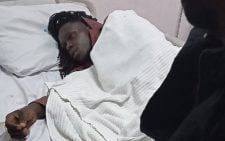
The only thing he remembers is finding himself at the Kenyatta National Hospital (KNH) where he had been rushed by fellow Gen Zs.
Despite numerous attempts by the doctors to remove the bullet, it remained lodged in his body, a permanent reminder of his harrowing ordeal. He now walks with the help of crutches and has since lost his source of livelihood as he cannot work.
“The leg is very painful. It has been operated on a couple of times, but the bullet is still lodged in my hip. The doctors said they could not remove it as it is risky. I’m constantly in pain and I depend on over-the-counter medicines for pain relief,” narrates the graduate.
Left by his family
Since then, Kinyanjui says life has been a constant struggle as he lost his young family, which he had just started, and is now forced to depend on good Samaritans for his sustenance.
“I was in the hospital for a month, and during that time, my wife and our six-month-old son had to leave because I could not provide for them. Since I was discharged, life has been a constant struggle, and I cannot fend for myself because I can no longer work,” he says.
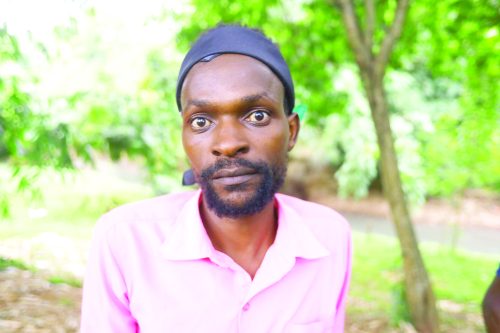
Kinyanjui narrates that as he still tries to come to terms with his reality of having a bullet inside his body and at least learn new skills, he now survives on the mercy of his friends and neighbours.
“I’m an orphan, I have no parents who can take care of me. My wife also left and returned to her parents with my child because I could no longer sustain them. I haven’t seen them ever since, and right now I only depend on my friends and neighbours,” he says.
Just like Kinyanjui, Dennis Wachira Wanjiku, 25, was shot twice on his right leg during the protests. However, his leg could not survive the injuries, forcing the medics to amputate it.
On the fateful day, the young man was at his place of work, where he worked as a car interior designer and a pastry baker. However, an urge to participate in the protests would see him go and join his peers.
“It was around 3:00 pm, I was already tired and thought I should go and eat. But just when I was leaving, I felt numb on my leg, only to realise that I had been shot twice,” he says, adding that after that, he remained unconscious for two days.
Wachira narrates that the bullet had severely injured him, shattering his bones. This saw him transferred to KNH.
Gave in to amputation
“My legs were swollen, and I was still bleeding and so I was taken to the theatre for an urgent surgery. Two days after the surgery, the injured leg started turning black, and it was already numb. The doctors suggested amputation, but I was willing to fight against all odds to have my leg,” he says.
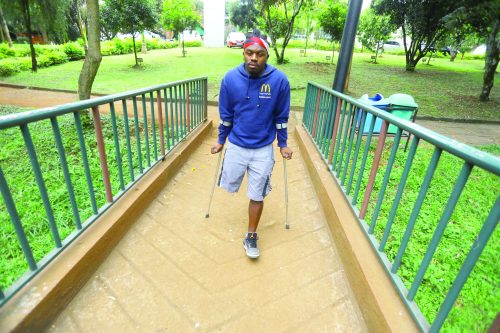
However, despite numerous failed efforts to save his leg, it had to be amputated.
“It was the toughest moment of my life, but I had to come to terms with it. The leg had begun to rot, and it was getting worse day by day. There was nothing to do anymore,” he recalls.
He would later be discharged from the hospital and had to re-strategise and adapt to his new life.
“My uncle, whom I was working for as a pastry chef, was kind enough to buy electric machines to make things easier for me. But still, I can’t do things the way I used to. It’s hard to move around, and most of the things I was passionate about, I can no longer do them,” he adds.
His mental health sometimes takes a toll on him, and he wishes he could have his leg back.
“There are days I even forget that I don’t have one leg. I try to wake up, and that’s when it hits me that I’m no longer able to literally stand on my two feet,” he narrates.
For Robert Mwabe, 32, his is a cry for justice. He was just on his normal daily routine, heading to work at a client’s home in Kahawa Wendani.
Mwabe, who was working in Kahawa Sukari as a welder, says that on that day, there were no matatus on the road and he had to trek to Kahawa Wendani since his client was waiting for him.
Shot from behind
While at the roundabout in Githurai, protests had intensified, and police started firing live bullets. As he was running for cover, he felt numb in his leg and lay down. His left leg was shot from the back with the bullet exiting from the front, destroying the whole front part of his leg.
“I lay there for a few minutes, and when people realised I was alive, they rushed to Neema Hospital, carried me on a boda boda. But the injury was too severe and I was referred to Thika level 5 and then to KNH the following day,” he recalls.
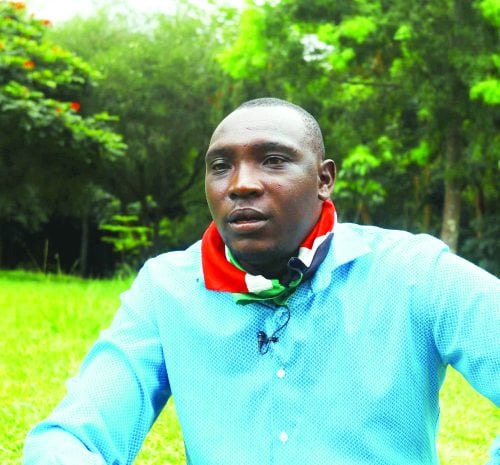
At KNH’s emergency ward, Mwabe narrates that the doctors said that his leg was no longer functional, but they would try to save it. And just like Wachira, he had to be amputated.
“I woke up from surgery the next day, and I had no leg. It was hard to accept. All along, I was hoping and praying that I wouldn’t get amputated. It hasn’t been easy, and I still haven’t come to terms with my situation,” narrates Mwabe.
He would leave KNH after two weeks and would be welcomed with another tough reality of unemployment, yet he has a family.
“Before, I was working as a welder. I used to weld roofs and use machines like a grinder. Now I can no longer do that,” says the father of one.
As he is adapting to living with a single leg, he is also learning how to use a prosthetic leg, which was donated to him. The difficult life, in addition to unemployment, has seen him explore a new venture as an Uber driver, and he hopes that life will soon get better.
Author
Cynthia Atuo
View all posts by Cynthia AtuoLatest News
Advertisement
More on News