Olekina defends Seed Bill as KEPHIS warns of food security risks
By Kenneth Mwenda, September 6, 2025A fresh row has erupted between Senator Ledama Olekina and the Kenya Plant Health Inspectorate Service (KEPHIS) over the Seeds and Plant Varieties (Amendment) Bill, 2025.
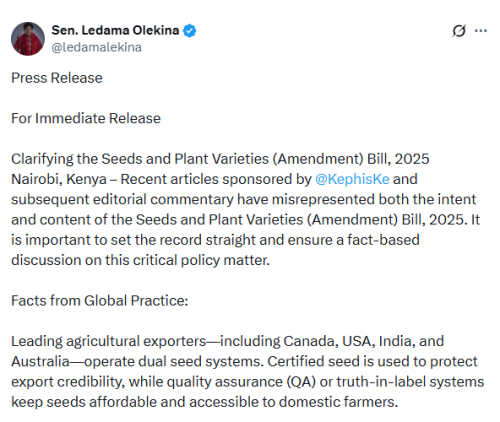
In a press statement on on X, on Saturday, September 6, 2025, Senator Olekina accused KEPHIS of sponsoring misleading narratives about the Bill.
“Recent articles sponsored by @KephisKe and subsequent editorial commentary have misrepresented both the intent and content of the Seeds and Plant Varieties (Amendment) Bill, 2025. It is important to set the record straight and ensure a fact-based discussion on this critical policy matter,” he said.
KEPHIS raises red flag
Earlier, in July, KEPHIS had urged the Senate to reject the Bill, warning that it could severely weaken seed quality control and put food security at risk. Board chair Joseph M’eruaki argued that introducing a standards-based registration system under the Kenya Bureau of Standards (KEBS) would create a parallel regulatory framework and cause confusion.
“KEPHIS regulates the quality of seed and provides certification, but it is now proposed that this function be transferred to KEBS, which will cause confusion,” he said. M’eruaki stressed that splitting the role between two ministries would fragment accountability and compromise oversight.
KEPHIS Managing Director Theophilus Mutui added that the agency’s mandate goes beyond seed certification to include inspecting vessels and containers to prevent pests from entering the country. He warned that the Bill could open the door to fake or poor-quality seeds, with devastating consequences for farmers and food production.
Olekina’s defence of the Bill
Senator Olekina, however, insists the Bill is designed to help farmers rather than harm them. He said Kenya currently spends millions sustaining an OECD-only certification system, yet only a few crops, such as sunflower, are exported under this framework. This, he argued, has resulted in unnecessary bureaucracy, high costs, and limited innovation.
The Bill seeks to retain certified seed for export markets while introducing a complementary quality assurance (QA) or truth-in-label system for domestic use. According to Olekina, this would make seeds more affordable, expand farmer access, and reduce regulatory delays.
“Certified seed is not the only credible system. By adopting both certification and QA models, Kenya can secure global market confidence while delivering affordability and innovation for its farmers,” he said.
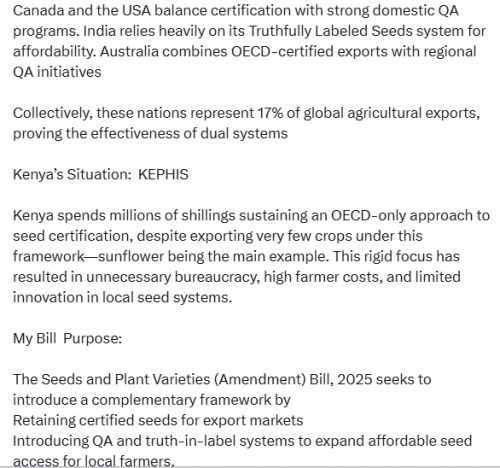
Olekina pointed to examples from countries like Canada, India, the United States, and Australia, which use dual systems to balance certified exports with affordable local access.
“Leading agricultural exporters—including Canada, USA, India, and Australia—operate dual seed systems. Certified seed is used to protect export credibility, while quality assurance (QA) or truth-in-label systems keep seeds affordable and accessible to domestic farmers. Canada and the USA balance certification with strong domestic QA programs. India relies heavily on its Truthfully Labeled Seeds system for affordability. Australia combines OECD-certified exports with regional QA initiatives.”
Collectively, these countries account for 17 per cent of global agricultural exports, proving the effectiveness of such models.